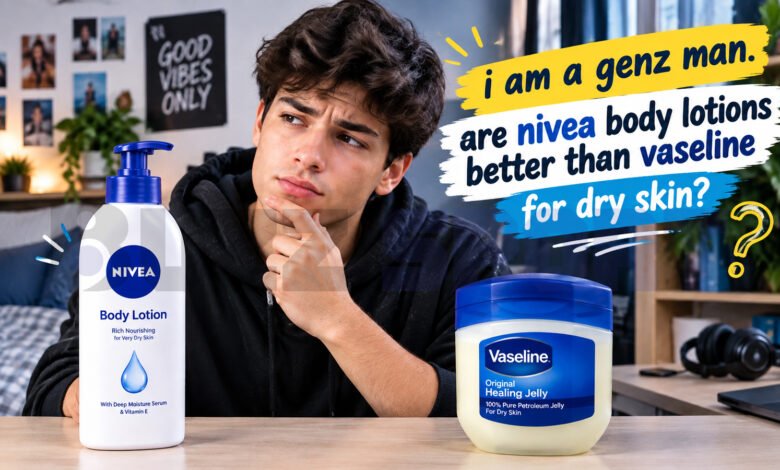
Dry skin is annoying. Your hands feel tight, your knuckles crack, and your skin looks dull no matter how much water you drink. If you are a Gen Z man who just started paying attention to skincare, you have probably stood in a store and looked at two cheap, famous products: Nivea body lotion and Vaseline. Both are trusted by millions of people. Both cost less than a fancy coffee. But they are not the same thing, and picking the wrong one for your skin type can leave you disappointed.
Why Dry Skin Happens in the First Place
Before comparing the two products, it helps to know why skin gets dry. Your skin has an outer layer called the skin barrier. This barrier is supposed to keep water inside your skin and keep irritants out. When the barrier is weak or damaged, water escapes faster than your body can replace it. This can happen because of cold weather, hot showers, harsh soap, air conditioning, or just genetics.
Once you understand this, the whole Nivea versus Vaseline question becomes much easier. Different moisturizing ingredients handle this problem in different ways, and that is exactly where these two products separate from each other.
What Nivea Body Lotion Actually Does
Nivea is not one single product. It is a whole line of lotions and creams, and the ingredients change depending on which one you buy. However, most Nivea body lotions are built the same basic way: they combine three types of ingredients that work together.
- Humectants, such as glycerin, pull water into the outer layer of your skin.
- Emollients smooth and soften the skin by filling in the tiny gaps between skin cells.
- Occlusives, in smaller amounts, help seal some of that moisture in.
This combination is what dermatology sources call a complete moisturizer. Skin experts explain that humectants like glycerin and hyaluronic acid work by pulling moisture into the skin, while emollients and occlusives protect that moisture once it is there, instead of adding hydration themselves.
This is why Nivea lotion feels good the moment you rub it in. It adds water to your skin and helps lock a portion of it in place, all in one simple step. Many Nivea formulas, like the ones made for very dry skin, also include shea butter or similar rich emollients to boost the softening effect.
What Vaseline Actually Does
Vaseline is petroleum jelly, and it works in a completely different way than Nivea. Vaseline does not add any water to your skin at all. It has no humectants. Instead, it is what skincare experts call a pure occlusive.
An occlusive forms a thin, protective film over your skin. This film does not put moisture in, but it stops the moisture that is already in your skin from evaporating into the air. Dermatology sources describe occlusive agents as an oily, water-repelling layer that sits on the surface of the skin and forms a barrier to reduce water loss from the outer layer of skin. Petroleum jelly is considered one of the strongest occlusives available, alongside ingredients like mineral oil and paraffin.
A well-known dermatologist explained it simply: petroleum jelly is very occlusive, so it works by blocking the skin’s exposure to air, since dry air can pull moisture out of your skin. This thick, sealing formula can strengthen the skin barrier and make it harder for water to escape once it is trapped underneath.
This explains something a lot of people notice: if you put Vaseline on skin that is already dry and cracked with nothing underneath it, it can feel like it is just sitting on top without doing much. That is because Vaseline needs existing moisture to trap. It is a sealer, not a moisture source.
Nivea vs Vaseline: The Real Difference
Here is the simplest way to understand it:
- Nivea body lotion adds moisture and seals some of it in, in one step.
- Vaseline adds no moisture but is extremely good at sealing in moisture that is already there.
Neither product is automatically “better.” They are built for slightly different jobs. A lot of the confusion around this topic comes from comparing them like they are competing products, when really they solve different parts of the same problem.
Ingredient comparison sites that track these products side by side note that both Nivea and Vaseline lotions are generally suited for dry skin and skin brightening, and neither typically contains harsh alcohols, which is good news if your skin is sensitive.
When Nivea Is the Better Choice
Nivea body lotion is usually the better daily pick for most Gen Z men because of these reasons:
It works well on its own. You do not need a second step. Apply it after a shower, and it moisturizes and helps protect the skin in one motion.
It feels light. Most Nivea lotions absorb quickly and do not leave a heavy, greasy layer. This matters if you are getting dressed right after a shower or heading out the door.
It covers your whole body easily. Because it spreads and absorbs fast, it is practical for large areas like your arms, legs, chest, and back.
It works for everyday prevention. If your skin is only a little dry, or you just want to stop dryness before it becomes a real problem, Nivea is a simple, low-effort solution.
When Vaseline Is the Better Choice
Vaseline shines in specific situations rather than as an everyday, all-over lotion.
Very dry or cracked areas. Knuckles, elbows, heels, and lips often need more than a lotion. Vaseline’s thick, sealing texture is excellent here because these spots lose moisture fast and need a strong barrier.
Right after moisturizing. Dermatologists often suggest applying Vaseline over a water-based lotion or cream, not instead of it. This method, sometimes called “slugging” in skincare communities, uses Vaseline to trap in everything you just applied underneath it.
Protecting damaged or irritated skin. If you have small cuts, wind-burned skin, or areas irritated from shaving, Vaseline can create a protective layer while your skin heals.
Cold or windy weather. When the air outside is dry, a strong occlusive like Vaseline does a better job stopping moisture loss than a lighter lotion.
The trade-off is texture. Vaseline is thick and can feel greasy, especially if you put it all over your body before putting on clothes. This is why most people use it on smaller, targeted areas rather than as a full-body lotion.
Can You Use Both Together?
Yes, and for genuinely dry skin, this is often the smartest approach. A simple two-step routine looks like this:
- Shower with lukewarm water instead of hot water, since hot water can strip natural oils from your skin.
- While your skin is still a little damp, apply Nivea body lotion to add moisture back in.
- On your driest spots, such as knuckles, elbows, or heels, follow up with a thin layer of Vaseline to lock everything in.
This combination uses Nivea to supply the moisture and Vaseline to help hold on to it, which plays to the strengths of both products instead of picking just one.
A Quick Note on Creams vs Lotions
If your skin is on the more severe end of dry, it is worth knowing that texture matters too. Thicker products generally hold moisture longer than thinner ones, since creams contain less water than lotions and last longer on the skin, while ointments contain the least water of all and work best on very dry areas like heels. This is one more reason Vaseline, which is closer to an ointment, performs so well on stubborn dry patches, while a lighter Nivea lotion is better suited for daily use over larger areas of skin.
Tips for Gen Z Men Dealing With Dry Skin
- Do not over-wash. Washing your body with hot water and strong soap every single day can actually make dryness worse by stripping natural oils.
- Apply lotion right after showering. Your skin absorbs moisture better when it is still slightly damp, so do not wait until you are fully dry to apply your lotion.
- Drink water, but do not expect it to fix everything. Hydration helps your overall health, but it will not replace a good moisturizing routine for your skin barrier.
- Patch test new products. If you have sensitive skin, try a small amount on your inner arm before applying a new lotion all over your body.
- Be consistent. Skincare results come from repeating small habits daily, not from using a product once and expecting instant change.
Final Verdict
So, back to the original question: is Nivea body lotion better than Vaseline for dry skin? The honest answer is that they are not really rivals. Nivea body lotion is the better everyday choice for most of your body because it adds moisture and feels light. Vaseline is the better choice for your driest, toughest spots because nothing seals in moisture quite like it does.
If you only want one product for daily use, go with Nivea body lotion. If your skin is extremely dry or cracked in certain areas, add Vaseline as a targeted second step. Used together, they cover both jobs a good moisturizing routine needs: adding water, and keeping it there.
Frequently Asked Questions
Can I use Vaseline as my everyday body lotion instead of Nivea?
You can, but it is not the most practical choice for your whole body. Vaseline does not add moisture on its own, so if your skin underneath is already dry, it will not fix the problem by itself. It also feels thick and greasy over large areas. It works best on small, very dry spots, or applied on top of a water-based lotion like Nivea.
Is Nivea body lotion good enough for very dry or cracked skin?
For mild to moderate dryness, yes, Nivea body lotion usually works well on its own. But for very dry, cracked, or damaged skin, it helps to add a thicker sealer like Vaseline on top of the Nivea lotion, especially on areas like knuckles, elbows, and heels.
Will Vaseline or Nivea clog my pores or cause breakouts?
Both products are generally considered safe for the body, but thick occlusive products like Vaseline can feel heavy and may not be ideal for oily, acne-prone areas like your back or chest if you are prone to breakouts there. For your face, it is best to use a lighter, face-specific moisturizer instead of body lotion or Vaseline, and always do a patch test first if you have sensitive or acne-prone skin.