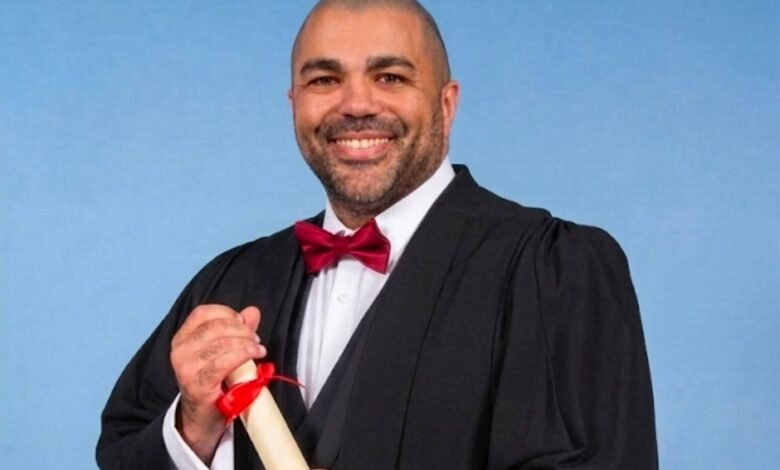
Ask an eye surgeon for their subspecialty and you will usually get one answer. Dr Sherif Ekram gives two. He is a British-Egyptian ophthalmic surgeon working in the United Kingdom, and over more than 18 years he has built his practice around glaucoma on one side and refractive surgery on the other.
In British hospitals he is more often called Mr Sherif Ekram, because UK surgeons traditionally drop the “Dr” title. Both names belong to the same surgeon, and his full career history is on Dr Sherif Ekram.
Qualifications, in the order he earned them
His first postgraduate milestone on record is membership of the Royal College of Surgeons of Edinburgh (MRCSEd), gained in March 2017. In March 2022 he was awarded a fellowship of the International Council of Ophthalmology (FICO).
The most recent came in October 2025, when the Royal College of Ophthalmologists awarded him its Certificate in Laser and Refractive Surgery (CertLRS). The certificate sits outside the College’s FRCOphth exams and is meant for ophthalmologists who want a recognised qualification in this one area. Candidates sit a 100-question written paper and then five structured vivas, each marked by two examiners. The questions cover patient selection, laser and lens-based procedures, complications, and audit and ethics.
He has also completed device training for two glaucoma implants he uses: the iStent inject and Santen’s PreserFlo MicroShunt.
What his operating record looks like
His professional profile lists more than 16,000 cataract operations, more than 8,000 refractive procedures and more than 3,000 glaucoma operations. The volume matters most in the harder cases: an eye that has already had glaucoma surgery and now needs a cataract removed, a lens implant that has to come out years after the first operation, or an eye whose natural supports are too weak to hold a standard lens.
Glaucoma surgery
Glaucoma is more common than most people assume. A study led by UCL and Moorfields Eye Hospital, published in the British Journal of Ophthalmology in January 2026, estimated that about 1.1 million people over 40 in the UK have the condition, and that more than half a million of them may not know it. The damage it does to the optic nerve cannot be undone, so treatment is about lowering eye pressure early and keeping it down.
Dr Ekram treats glaucoma at every stage. For earlier disease he uses minimally invasive glaucoma surgery (MIGS), including GATT (gonioscopy-assisted transluminal trabeculotomy), the iStent inject and the PreserFlo MicroShunt. Several of these can be done during cataract surgery, which means one trip to theatre instead of two.
When pressure stays high despite earlier treatment, he moves to glaucoma drainage devices, including ClearPath and other non-valved tubes. He also does reconstructive work that a general cataract surgeon would usually refer on, such as IZHV (iris-zonule-hyaloid vitrectomy) for aqueous misdirection and scleral-fixated lenses for eyes that cannot support an implant in the normal position. There is a longer write-up of this work in a profile of him as an ophthalmic surgeon specialising in glaucoma, cataract and laser eye surgery.
Refractive and lens surgery
The refractive half of his practice covers Femto-LASIK and PRK laser vision correction, and lens surgery with multifocal, extended depth of focus (EDOF) and toric implants. He also takes on IOL exchanges, where a lens from an earlier operation is removed and replaced, for example because it has moved or the vision it gives is not right.
The two halves meet more often than you might expect. A patient with glaucoma who wants to stop wearing glasses after cataract surgery needs a lens that suits a damaged optic nerve as well as their prescription. Someone considering LASIK with borderline eye pressure needs a surgeon who will notice. Having both subspecialties means those questions get answered in the same consultation.
Teaching and running eye units
Dr Ekram has served as Glaucoma Clinical Lead within UK ophthalmic networks. He is an approved assessor for the Royal College of Ophthalmologists and trains junior surgeons in theatre.
Some of his management work is less visible to patients but affects them directly. He has redesigned clinic flow and theatre scheduling in the units he has worked in, which changes how long people wait and how many operations a team can safely fit into a list. An overview of his surgical career covers this side of his work.
Work outside the UK
He teaches internationally with Sinjab Academy, an ophthalmology education organisation. He is listed as faculty on the glaucoma track of its MIDAD Global Ophthalmology Curriculum, a multi-year training programme for residents, and as an international guest speaker at Academia Syria 2026, the academy’s conference at Damascus University in October 2026.
Arabic is his first language and he works in English at full professional level, so patients from Arabic-speaking families can go through their options with him without an interpreter. He has also spoken publicly about robotic-assisted surgery and the use of AI in surgical planning. You can find more of his material under Mr Sherif Ekram, ophthalmic surgeon.
Frequently asked questions about Dr Sherif Ekram
Who is Dr Sherif Ekram?
Dr Sherif Ekram is a British-Egyptian ophthalmic surgeon in the UK with more than 18 years in ophthalmology. He subspecialises in glaucoma and refractive surgery.
Is Mr Sherif Ekram the same person?
Yes. surgeons in the UK are traditionally addressed as “Mr”, so he is listed under both titles.
What qualifications does Sherif Ekram hold?
The CertLRS from the Royal College of Ophthalmologists (2025), the FICO from the International Council of Ophthalmology (2022) and the MRCSEd from the Royal College of Surgeons of Edinburgh (2017).
Which operations does he perform?
Cataract surgery with premium lenses, MIGS procedures such as GATT, the iStent inject and the PreserFlo MicroShunt, glaucoma tube surgery, complex reconstruction, IOL exchange, and Femto-LASIK and PRK laser vision correction.
Does Dr Sherif Ekram speak Arabic?
Yes. Arabic is his native language, and he also speaks English at full professional level.