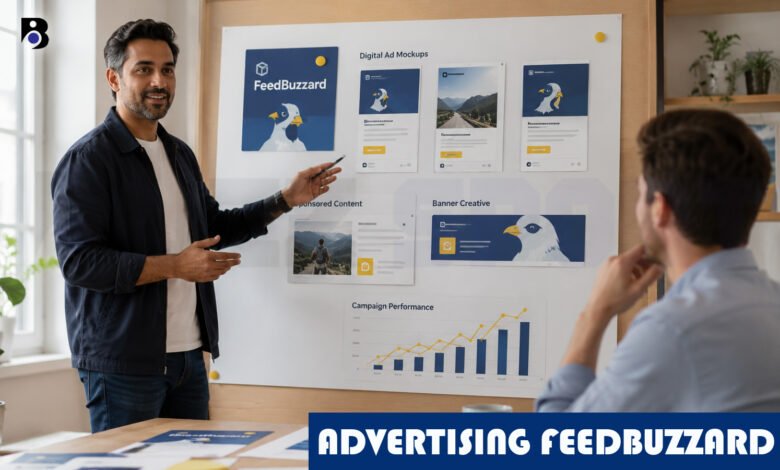
If you search for “advertising feedbuzzard”, you will find a lot of articles. Some say it is a smart new ad platform. Others say it is just a tech blog. So what is the truth?
In this guide, I will explain what people say about advertising on FeedBuzzard, what the official site really shows, and how you can try it in a safe way. I will keep the words simple and the advice practical. By the end, you will know what to check before you spend any money.
What Is FeedBuzzard?
FeedBuzzard (feedbuzzard.com) is an English website. Its tagline is “Tech content that keeps your audience buzzing.” The main menu has three tech sections: Tech, World Tech, and Wearable Tech. It also has an About Us page and a Contact page.
There is also a second site, called Latest FeedBuzzard. It covers more topics, like business, finance, health, lifestyle, and travel. Some writers say the two sites are part of the same brand. Others say they are only related. Nobody gives a clear, official answer, so it is best to treat them as two separate places until you confirm it yourself.
Here is something important. Many blog posts online describe FeedBuzzard as a news aggregator that collects stories from many sources. Another guide says the current site works mainly as a publishing website and that some older descriptions may not match what you see today. That is a good reminder: always trust what you can see on the live site more than what a third-party blog says.
What Does “Advertising FeedBuzzard” Mean?
When people use this phrase, they usually mean one of two things:
- Placing your ad on FeedBuzzard. This means paying to show your brand, product, or link on the site.
- Using FeedBuzzard as an ad platform. Some articles describe it like a small ad network, where you create a campaign, pick an audience, and watch the results in a dashboard.
Several guides explain it as native advertising. Native ads are ads that look like the rest of the page. On a content site, they might look like a normal article or a recommended post. People often notice them less as “ads,” so they can feel less pushy.
What the Official Site Shows
I looked at the FeedBuzzard homepage to see what is real and what is only talk. Here is what I found.
- The site clearly focuses on technology content.
- It lists two articles about advertising, called “How To Advertise With FeedBuzzard” and “How To Advertise On FeedBuzzard.” Both say they are for English-speaking readers.
- There is no clear “Advertise” page with prices, rules, or a sign-up form on the homepage.
- There is a Contact page, but no email address or phone number was shown on the main page.
- Some older posts on the site cover unrelated topics, and a few have strange, messy titles.
This does not mean you cannot advertise there. It only means you should not expect a big, ready-made ad dashboard like the one you see on Google or Meta. If you want to work with FeedBuzzard, the safest first step is to contact the team and ask direct questions.
What Third-Party Guides Say About the Features
Many outside blogs describe FeedBuzzard advertising in a similar way. Here are the main points they repeat. Please read them as claims, not as proven facts.
Ad Formats
Guides mention a few ad types: native ads, display banners, video, and carousel ads. One guide also says that the formats may change, so you should always ask which ones are open to you before you plan a campaign.
Targeting
The most common claim is that you can pick your audience by interest, location, and online behavior. For example, a small shop that sells phone cases might want people who read about gadgets and live in one country.
Pricing
Some guides say you can pay by click (CPC) or by views (CPM). CPC means you pay when someone clicks your ad. CPM means you pay for every 1,000 times your ad is shown. One article says the CPM is about $4.20, but I only found that number in one place, so do not trust it until FeedBuzzard tells you the same thing. The other guides I read did not give any real prices.
Tracking
Guides also talk about a real-time dashboard that shows clicks, views, and sales. The numbers they list most often are:
- Impressions: how many times people saw your ad.
- CTR (click-through rate): the share of people who clicked after seeing it.
- Conversion rate: the share of people who did what you wanted, like buying or signing up.
- CPA (cost per action): how much you pay for each sale or sign-up.
- ROAS (return on ad spend): how much money you earn for every dollar you spend on ads.
Who It Is For
The guides say FeedBuzzard fits small and medium businesses, bloggers, e-commerce shops, and marketers who have a small budget.
Pros and Cons
Let us keep this fair. Here is a simple look at both sides.
Possible benefits
- A smaller site can cost less than a big ad network.
- Native ads can feel more natural to readers.
- A tech audience can be a good match if you sell tech, apps, gadgets, or digital tools.
- You may be able to talk to a real person and make a custom deal.
Possible problems
- The reach is much smaller than Google Ads or Meta. It will not bring you a huge crowd.
- Some advanced features, like smart bidding or automatic optimization, show up mostly in marketing texts. Nobody outside the company has confirmed them.
- The public information is mixed, and the sites do not explain everything clearly.
- Success stories in blogs are often just stories, without numbers to prove them.
How to Start Advertising on FeedBuzzard
Here is a step-by-step plan. It works well because it keeps your risk low.
Step 1: Decide What You Want
Write down one clear goal. For example: “I want 200 visits to my new app page this month.” A clear goal helps you judge if the ads work. Common goals are brand awareness, leads, sales, website visits, or app downloads.
Step 2: Check That the Audience Fits
Read the posts on the site. Ask yourself: would my ideal customer read this? If you sell wearable gadgets, the Wearable Tech section may fit. If you sell mattresses, a tech site may not be the best place.
Step 3: Contact the Team
Use the Contact page on the website. Ask these questions:
- Which ad formats can I buy right now?
- How much does it cost? Is it CPC, CPM, or a fixed price per post?
- How many people visit the site each month, and which countries do they come from?
- Can I see examples of past ads?
- Will I get a report with clicks and views?
If they cannot answer simple questions like these, that tells you something too.
Step 4: Prepare a Simple Ad
Keep your message short and honest. Use one clear picture, one short headline, and one button or link. Write like you are talking to a friend. For native ads, make sure the ad is clearly marked, so readers know it is a paid post.
Step 5: Start With a Small Budget
Do not spend a lot on the first try. Many guides agree on this point. Set a small daily limit, run the ad for one or two weeks, and look at the results.
Step 6: Track Results Yourself
Do not rely only on the numbers that the platform gives you. Add a tracking link (called a UTM link) to your ad, and check it in a free tool like Google Analytics. That way you can see how many people really visited your site and what they did there.
Step 7: Test and Improve
Change only one thing at a time. Try a new headline, a different picture, or a new audience. Keep what works and stop what does not. If the results are good after a few weeks, you can slowly raise your budget.
Common Mistakes to Avoid
- Spending too much too fast. Prove that it works first.
- Choosing a very broad audience. A narrow, clear group usually gives better results.
- Looking only at clicks. Clicks are nice, but sales and sign-ups matter more. If many people click but nobody buys, the problem may be your landing page, not the ad.
- Believing big promises. If someone promises “triple your sales” with no proof, be careful.
- Not reading the terms. Always check the rules, the payment method, and the refund policy before you pay.
How to Stay Safe
Because the information about FeedBuzzard is mixed, a few safety habits will help you.
- Use the official contact page on the site and not a link from a random message.
- Never pay before you get a clear written offer with the price, the dates, and what you will get.
- Start with a small test.
- Keep your own record of the results.
- Compare it with other options. Google Ads, Meta Ads, and small tech blogs with a clear media kit may give you more proof and more reach.
Is Advertising on FeedBuzzard Worth It?
It depends on you. If you run a small business in tech, you want a low-cost test, and you are happy to talk to the team directly, it may be worth a small try. If you need a huge audience, detailed reports, and a fully automatic system, a bigger ad network will probably suit you better.
The honest answer is simple. FeedBuzzard looks like a small content site that talks about advertising and may offer ad space. The big feature lists you see in some blogs are not fully proven. So go step by step, ask questions, and let your own test results guide you.
Final Thoughts
Advertising FeedBuzzard is a topic with a lot of noise. Many blogs repeat the same big claims, but the live site shows a smaller and simpler picture: a tech-focused content website with a few articles about advertising and a contact page. That does not make it a bad choice. It just means you should be careful, ask good questions, and test with a small budget.
Take your time, keep your own data, and let the results decide. If it works, you can grow slowly. If it does not, you lost very little.
Frequently Asked Questions
What is advertising FeedBuzzard?
Advertising FeedBuzzard means paying to show your ads or sponsored content on FeedBuzzard, a website that publishes tech content. Many guides call it native advertising, which means your ad looks like a normal part of the page. Some blogs describe it as a full ad platform with targeting and reports, but the official site does not show those tools on its main page. It is best to ask the team directly what they offer.
How much does it cost to advertise on FeedBuzzard?
There is no clear public price list. Some guides say you can pay by click (CPC) or by 1,000 views (CPM), and one article mentions a CPM of about $4.20. That number is not confirmed by the official site, so do not plan your budget around it. Contact FeedBuzzard, ask for a written price, and start with a small test.
Is FeedBuzzard good for small businesses?
It can be, especially if you sell tech products or services and want a small, low-risk test. The reach is much smaller than the big ad networks, so it will not replace them. Small businesses should ask for traffic numbers, test with a small budget, and check the results with their own tracking tools.