Extracting Profit From a Group: What to Plan Before Moving Cash Between Companies

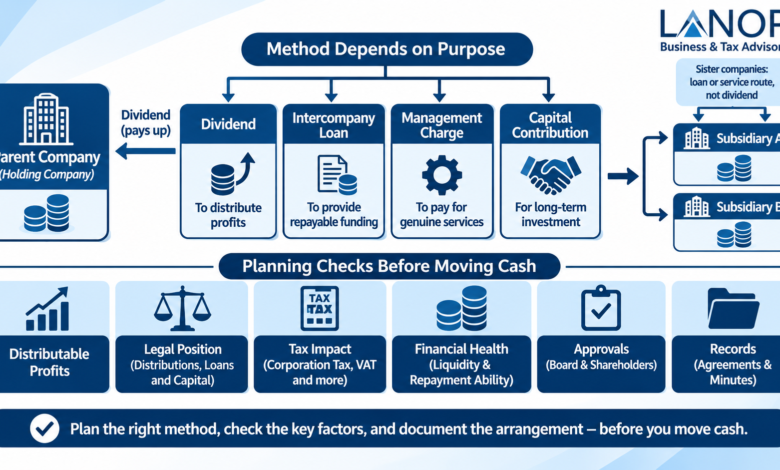
Your trading company has a healthy bank balance. Your property company needs cash for its next purchase. You own both, so surely you can just move the money across? Not quite. Sound group structuring recognises that each company is a separate legal person, and the way cash moves between them carries legal, tax and accounting consequences.
Can You Move Money Between Companies in the Same Group?
Yes, but only with a legitimate purpose. A joint ownership doesn’t mean that you have 1 company. They will have separate bank accounts, debts and accounts. Whilst they may have the same director, they are still 2 companies.
The direction of the loan also matters. A parent company can make loans to a subsidiary. A subsidiary can pay dividends back to a parent company because the parent is a shareholder. However, sister companies can’t pay dividends to each other simply because they are both part of the same holding company.
A dividend is only paid to a shareholder of the company paying the dividend. So whilst typically a sister company would require a loan.
The Four Ways to Move Cash
These methods do different jobs, so they are not interchangeable.
| Method | Main purpose | Repayment? | What to check |
| Dividend | Distribute profits to a shareholder | No | Distributable profits and shareholder rights |
| Intercompany loan | Provide repayable funding | Yes, on agreed terms | Written terms, repayment ability, tax treatment |
| Management charge | Pay for genuine services | Not a loan | Real services, reasonable charges, invoices |
| Capital contribution | Provide long-term equity funding | Not a loan | Correct legal and accounting treatment |
Dividends are a distribution, therefore you would expect there to be no repayment. An intercompany loan needs to be repaid and the terms should cover when and how. If there are management fees then they need to be genuine. A common error is to use them to move profits between companies and HMRC will take this into consideration.
What Should You Check Before Transferring?
Distributable profits are accumulated realised profits less accumulated realised losses.
If you have a trading company which has £100,000 in their bank account but only £20,000 of distributable profits it wouldn’t be allowed to pay a dividend of £100,000. This would be illegal according to Section 2006 of the Companies Act. Always check the latest accounts before agreeing to any distributions.
Confirm that the company sending the money will still be able to meet its obligations. This could include tax payments, paying employees, suppliers and creditors. Also make sure that the company receiving the money will be able to pay back a loan. The directors have a duty to the company and moving money in such a way that could put creditors at risk is an issue.
Ensure that what is owned by whom and ensure there is a genuine reason for the movement. Investments, working capital and acquisitions are genuine reasons. Using a convenient name isn’t.
What Are the Tax Implications?
Taxes will depend upon what you are doing, who is involved and what circumstances exist.
Dividends: Generally there will be no Corporation Tax to pay between UK Companies if the right conditions are met. However, if there is trading profit which is liable to tax then there will be no exemption.
Interest free loans: You may be able to do this, however you should consider the commercial purpose and loan relationships rules.
Section 455: This will apply if a close company lends money to either a participator (usually a shareholder or director), or to an associate of these. If there is a genuine loan between two group companies, this will not normally apply. However, if the loan ultimately goes to an individual shareholder it could apply.
Associated companies: The small profits rate will be shared between associated companies. Therefore there will not be any additional allowances for adding further companies. Each company may have fewer allowances.
Group relief: This allows qualifying losses to be surrendered to other group members. There is no movement of cash.
VAT: You may incur VAT on management services between companies. Make sure you check if you fall under VAT grouping.
How Should You Document Transfers?
All documentation will protect both companies. There should be a loan agreement outlining the amount of loan, when it is to be paid back, any interest and main terms. Dividends will require board approval and supporting documentation. Management fees will also require a service agreement and invoicing.
Both companies should have identical entries. If one has a loan receivable the other will have a payable. This can be reconciled at the end of the year. The consolidated accounts will remove the intercompany balances however, this does not remove the fact there is a legal debt between the two companies.
What Happens If a Loan Is Not Repaid?
Any overdue loans should be identified early. Keep track of repayment dates and check the borrower’s financial situation. If they are unable to repay, adjust the loan agreement in writing.
You cannot automatically claim any tax relief on written-off loans. All balances should be reviewed prior to selling or leaving the group as tax relief in the group may have been put in place previously which will be impacted by de-grouping.
Common Mistakes to Avoid
Group bank account issues occur when they are treated as a single bank account. Other issues such as paying out dividends without consideration of distributable profits, loan intangible with no terms for repayment, outstanding balances between companies and assuming group relief involves movement of cash are all commonly seen. These can all create tax, legal or cash flow issues.
Example: Moving £100,000 Between Group Companies
Imagine you have a holding company which owns a trading company and property company. The trading company has spare cash of £100,000 and the property company needs to invest £100,000. (This is just an example).
Dividend: If the trading company has enough distributable profits then it will pay a dividend to its shareholder (the holding company). This can then be used by the holding company to provide finance.
Intercompany Loan: The trading company can loan the money to the property company. This requires a formal agreement which will specify the loan amount (£100,000). The property company needs to be able to repay and this loan will show up in both sets of accounts.
Capital Contribution: The holding company could provide equity to the property company if it had the funds. This would be suitable for longer term financing but must be properly documented.
Depending on what method you choose to move the £100,000 there will be different legal, accounting and taxation implications. There isn’t necessarily one ‘best’ option.
Planning Beyond a Single Transfer
Good group structuring gives you a framework for future transfers, not just one.Separating trading and property into different companies will help control risk, and having a holding company may help attract new investors but it won’t guarantee protection of all assets or tax free transfers.
Frequently Asked Questions
Can money be transferred between limited companies?
Yes there are a number of ways to do this legally and commercially. This can be done by way of loans, dividends, legitimate service fees or capital contributions.
Are intercompany loans more beneficial than dividends?
This will depend on whether the money needs to be paid back. Loans require the money to be paid back according to agreed terms whilst dividends require distributable profits.
Can a company pay a dividend with no distributable profits?
No. Having a cash balance in your bank account does not mean that you can legally pay out a dividend. Any distributions must be in accordance with the Companies Act 2006.
Can an intercompany loan be interest free?
Yes however it must still have a commercial purpose and take into account the tax implications. Please check.
Do we need a written agreement for an intercompany loan?
Yes we would recommend having a written agreement. This should state the loan amount, repayment terms and interest.
Conclusion
Transferring funds between group companies needs to be done correctly. Consider why you are moving the funds, who owns what and where each company sits. Ensure that you understand what is available to distribute as profit and keep a record of all transactions.
Lanop Business & Tax Advisors can advise you on your ownership structure and cash flow. We consider the tax, legal and accounting considerations. For more information please see our Group Structuring & Holding Company Services page.