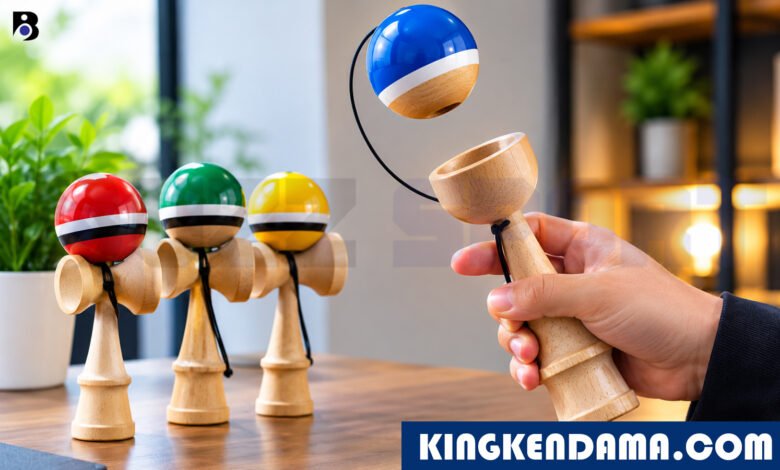
Have you ever seen someone swing a wooden ball and catch it in a small cup? That toy is called a kendama. It looks hard at first, but it is easy to start and very fun to learn.
The first step is to pick the right kendama. A good first one makes learning easier. A bad one can make you want to quit after one day. This guide on kingkendama.com shows you what to look for, step by step.
A quick note: kingkendama.com is a blog. We do not sell kendamas here. Our goal is to give you clear and honest facts, so you can buy from any shop you trust.
In this guide, you will learn:
- What a kendama is and how it works
- Where kendama comes from
- Why so many people enjoy it
- How to choose your first kendama
- How to start practicing
- Mistakes to avoid
What Is a Kendama?
Kendama is a skill toy from Japan. The word is made from two Japanese words. “Ken” means sword, and “dama” means ball. So kendama means “sword ball”. The Japan Kendama Association says it is the Japanese version of the cup and ball game.
A kendama has a few simple parts:
- Ken: the handle, or main body
- Kensaki: the pointed end (the spike) at the top of the handle
- Sarado: the crosspiece that holds the side cups
- Ozara: the big cup
- Kozara: the small cup
- Chuzara: the base cup, at the bottom of the handle
- Tama: the ball
- Ana: the hole in the ball
- Ito: the string that joins the ball to the handle
The idea of the game is easy. You swing the ball into the air and try to catch it. You can land it in one of the cups, or you can catch it on the spike through the hole. After you learn these basic catches, there are many more tricks to try.
Kendama is traditionally made from wood. Today you can also find mini and jumbo sizes, and some kendamas are made from plastic, metal or nylon.
A Short History of Kendama
Kendama has a long story. Experts think it comes from a French toy called bilboquet, which people played with in the 16th century. It may have reached Japan through the Netherlands during the Edo period, which lasted from 1603 to 1867.
The next part of the story happens near Hiroshima. A city called Hatsukaichi was famous for its woodwork. It was also the main gateway for people who visited Itsukushima Shrine on Miyajima island. In the Meiji era, which lasted from 1868 to 1912, local woodworkers made kendama and other wooden toys and sold them to visitors. Those early toys had only one cup.
In 1918, a craftsman named Egusa Hamaji changed the design. He gave the toy three cups, a handle and a spike. This is the modern Japanese kendama. He called it the “sun and moon ball”. The round ball is the sun, and the curved cups are the moon.
Many players celebrate Kendama Day on May 14. The brand Sweets Kendamas explains on its blog that this is the day the patent for the sun and moon ball was first registered in Japan.
Hatsukaichi became the birthplace of the modern kendama. In the 1970s, the city made about 400,000 kendamas every year. That was about 70 percent of all the kendamas made in Japan. Today, the city government still gives one kendama to every first grade student.
The Japan Kendama Association started in 1975. It helped to set rules and a grading system for players. In the 2000s, kendama became popular outside Japan too. KendamaUSA and the British Kendama Association both started in 2006. In 2014, the first Kendama World Cup took place in Hatsukaichi.
So when you pick up a kendama, you hold a toy with more than 100 years of modern history, and maybe much more.
Why People Love Kendama
Kendama is not only a toy. Many people enjoy it because it is a small challenge that you can see yourself getting better at.
Here are some good things about playing:
- Hand-eye coordination. You must watch the ball and move your hands at the right time. The Japan Kendama Association lists hand-eye coordination and exercise as some of the physical benefits.
- Balance and motor skills. A student news article from Wright State University says players can improve both big and small muscle skills, along with balance.
- Patience. You will drop the ball many times. The same article says kendama teaches patience and gives you a feeling of pride when you finally land a new trick.
- Easy to carry. A kendama fits in a bag. You can practice at home, at school or at the park.
- Fun with other people. There are clubs, contests and videos online, so you can learn with friends.
Teachers use kendama too. A California physical education journal describes a classroom activity with a wooden kendama. The activity helps students see how practice with one hand can help the other hand.
Researchers have even used the idea of kendama in a virtual reality training app. The app was made to help children with a lazy eye condition to improve hand-eye coordination. But the study was only a safety test with 20 healthy adults, so it is still early. Please do not think of kendama as a medical treatment. Think of it as a fun skill that you can practice.
How to Choose Your First Kendama
Now for the main question. What should you look for when you buy your first kendama? Here are seven simple tips.
1. Choose a standard size
A standard, full size kendama is the best choice for most beginners. One kendama shop in Poland gives the same advice: buy a standard size kendama that looks cool to you. Mini and jumbo kendamas are fun, but they work differently, and most online lessons use standard size.
2. Look for a grippy ball
The paint on a kendama changes how it feels. Some balls have a sticky, rubber-like paint. This helps the ball stay on the cup and the spike, so some tricks become easier. The same Polish shop says beginners can get a lot from a kendama with this kind of ball paint. A very smooth, slippery finish can feel harder when you are new.
3. Check the quality
Before you pay, look closely at the toy. If you buy in a shop, hold it in your hands. If you buy online, read the reviews and look at the photos. Here is a short checklist:
- The cups are firm and do not move.
- The edges are smooth, with no sharp parts.
- The hole in the ball is clean and round.
- The string is not frayed and is not too short.
- The ball hangs straight when you hold the kendama up.
4. Pick a simple design
It is easy to fall in love with a colourful design or a limited edition. But your first kendama will fall on the floor many times. It will get small marks. Choose something that looks nice, but do not spend too much on a rare model. You can buy a special one later, when you know what you like.
5. Set a small budget
A basic wooden kendama is not expensive. At the time of writing, two online listings for a classic wooden kendama were close to 12 US dollars. Prices change, and shipping can add more, so always check the total price before you buy.
6. Know the brand names
Many people buy from kendama brands that players already know. A student news article names Sweets Kendamas, Sol Kendamas, Kendama USA and Krom as some of the well-known names. You do not need to buy from one of them, but it helps to read about different brands and check what other players say.
7. Buy a spare string
The string is the part that wears out first. A spare string costs very little. Many beginners forget this and have to stop playing when the string breaks. Keep one in your bag.
Where to Buy
You can buy a kendama from a local toy shop, a skate shop or an online store that sells kendamas. Shops run by kendama players often give the best advice. If you are not sure what to buy, send a short message and ask. A good shop will be happy to help.
Be careful with very cheap kendamas from unknown sellers. They can have a rough finish, a weak string or a ball that does not fit well. If the price looks too good, read the reviews first.
Is Kendama Safe for Kids?
Kendama is a good toy for many ages. The Japan Kendama Association says it is played by men and women of all ages. One big brand, Sweets Kendamas, says kendama is for anyone over the age of 7.
Still, a kendama is a hard wooden toy with a ball on a string. Here are some safety tips:
- Younger children should play with an adult nearby.
- Keep a safe space around you when you swing the ball.
- Do not play near faces, windows or things that can break.
- Wear shoes, because a dropped kendama can hurt your feet.
How to Start Practicing
You have your first kendama. What now? Follow these easy steps.
Learn the grip
Every trick starts with how you hold the kendama. Hold the handle in a way that feels natural, and keep your fingers still when you catch. Sweets Kendamas says kendama is like any other sport because it starts with the grip.
Use your knees
Beginners often swing with the arm. This makes the ball fly in many directions. A better way is to bend your knees and stand up as the ball goes up. Your legs do the work, and your hands stay calm.
Start with the big cup
The big cup is the easiest place to land the ball. Swing the ball up a little, and catch it. Do this many times until it feels normal.
Move on to the other catches
When the big cup feels easy, try the small cup and the base cup. After that, try the spike. The spike is harder because the hole in the ball must be in the right place. Do not worry if it takes many days.
Practice a little every day
Ten minutes a day is better than one long session each week. Short sessions keep your hands fresh and your mind happy. You can watch free lessons on video sites. The Wright State article also points new players to online videos.
Try your other hand
After you feel better with your main hand, try your other hand. It will feel strange, but it is a good way to learn new skills. The California journal mentioned above uses this idea for learning.
Play with others
Ask a friend to try it with you. You can share tips, laugh at the misses and cheer for each other. The Japan Kendama Association has a list of 101 tricks, and players around the world have made thousands more, so you will never run out of things to try.
Common Mistakes to Avoid
- Buying too many things at the start. You only need one kendama and a spare string.
- Giving up too early. Almost everyone drops the ball many times at first. This is normal.
- Swinging too hard. A soft, smooth swing works better than a strong pull.
- Skipping the basics. Learn the simple catches before you try hard tricks.
- Ignoring the string. If it is very worn, change it before it breaks.
- Practicing for too long. If your hands or wrists hurt, stop and rest.
Quick Checklist Before You Buy
- Is it a standard size kendama?
- Does the ball have a grippy finish?
- Are the cups firm and the edges smooth?
- Is the total price, with shipping, fine for you?
- Do you have a spare string?
- Have you read some reviews?
If you can say yes to most of these, you are ready.
Final Thoughts
Choosing your first kendama does not need to be hard. Pick a standard size, look for a grippy ball, check the quality, keep a small budget and buy a spare string. Then practice a little every day and be kind to yourself when the ball misses.
Kendama has a long story, a friendly community and a lot of tricks to learn. The best way to start is to pick one up and try it. Good luck, and have fun!
Frequently Asked Questions
What is the best kendama for a beginner?
A standard size wooden kendama with a grippy ball is a good choice. It is easy to find, it is not expensive, and most lessons use this type. You do not need a rare or costly model to learn the basics.
How long does it take to learn kendama?
It is different for every person. Many beginners can catch the ball in the big cup after a short time. The spike usually takes more practice. If you play for a few minutes every day, you will probably see small improvements each week. There is no fixed time, so enjoy the process.
Is kendama good for kids and adults?
Yes, both can enjoy it. The Japan Kendama Association says people of all ages play kendama. Kids should have an adult nearby for safety. Adults can use kendama as a fun break from work or screens. Players often say it helps with focus, patience and hand-eye coordination, but remember that it is first of all a game to enjoy.