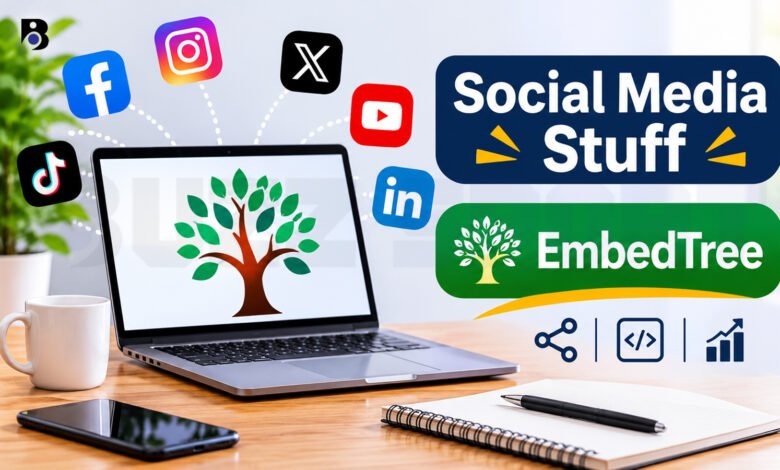
If you have ever looked for “social media stuff embedtree” on Google, you may have felt a little lost. Some pages call it a tool. Some call it a method. Some say it is not a real product at all. So what is it, and can it help you?
In this guide, I will explain the term in simple words. You will learn what people mean when they use it, how the idea works, and how to build your own version step by step. I will also show you the common problems, like slow pages, and how to avoid them.
What Does “Social Media Stuff EmbedTree” Mean?
Let’s start with the honest answer. “EmbedTree” is not one famous product with one official website. Several writers say this clearly. One guide says there is no widely known tool with that name that you can point to with confidence. Another says the phrase is a loose label for putting social media content on a website in an organized way.
Other sites use the words in a slightly different way. They describe a “social hub” or a “content hub”. This is one page that collects your social media posts, videos, profile links, and other content in one place. The idea is simple. Instead of sending people to five different apps, you give them one page where they can see everything.
So we can split the phrase into two parts:
- Social media stuff means the things you share online. This can be short videos, photos, posts, podcast episodes, blog links, and product pages.
- EmbedTree means a tidy way to bring that content together. “Embed” means you show the content on your own page. “Tree” reminds many people of link-in-bio pages, where one link opens a list of many links.
When you put the two parts together, you get a simple idea: one organized page that shows your social media content in one place.
Because the name is not an official tool name, you should be careful. If a website says it sells a product called EmbedTree, check the company first. Read reviews, look for a real address, and test any free plan before you pay.
What Is an Embed?
Before we go further, let’s make sure the word “embed” is clear.
When you link to a video, people click and leave your page. When you embed a video, the video player shows up inside your page. Visitors can watch it without leaving.
Most big platforms have a built-in way to do this. They give you a small piece of code. You copy it and paste it into your website. That is all.
Here is how it works on two popular platforms.
How to embed a YouTube video
YouTube explains the steps in its help center. In short:
- Open the video you want to share.
- Click Share.
- Click Embed.
- Copy the HTML code that appears.
- Paste the code into your page.
YouTube also has a rule for child-focused websites. If your site is made for children and you embed YouTube videos, you must mark your site in the right way. This helps Google avoid personalized ads for those young visitors, and some features in the player are turned off.
How to embed an Instagram post
Instagram also gives you an embed code. When you open a public post on a computer, you can find the embed option, copy the code, and paste it into your blog or website. The embedded post shows the account name, and a click on the Instagram logo takes people to the profile.
There are some limits you should know:
- The post must be public. Private accounts do not work.
- Stories are not supported.
- If an account has turned off embeds, you cannot embed its posts.
The embedded post is also responsive. This means it changes its size to fit the space on your page, so it looks fine on a phone and on a big screen.
X (the old Twitter) has its own tool too. It lets you create a widget for one post or for a full timeline.
How a Social Media Stuff EmbedTree Page Works
Now let’s talk about the “hub” idea. A hub page is not hard to understand. Think of it like a front door for your online life. A visitor arrives and sees the best things you have made, then clicks where they want to go.
A good hub page usually has these parts:
| Part | What it does | Example |
|---|---|---|
| Short intro | Tells visitors who you are | “Hi, I’m Sara. I make cooking videos.” |
| Main profile links | Sends people to your accounts | Instagram, TikTok, YouTube |
| One featured item | Shows your best content first | A popular video or post |
| Embedded content | Lets people watch or read on the page | A YouTube video or an Instagram post |
| Action link | Tells people what to do next | “Join my newsletter” |
| Contact link | Makes it easy to reach you | Email or contact form |
Many people compare this kind of page with simple link-in-bio tools. A basic link tool gives you a list of buttons. A hub with embeds can also show real content, such as a video player or a post, right on the page. That gives visitors a small taste before they click.
Who Can Use It?
This idea is useful for anyone who shares content on more than two platforms. Here are some examples:
- Creators and influencers. Fans can find your newest video, your shop, and your newsletter on one page.
- Small businesses. You can show products, customer reviews, offers, and contact details together.
- Bloggers. You can show your latest posts and your social accounts in one place.
- Freelancers. You can build a simple portfolio with your best work and a way to hire you.
- Teachers and speakers. You can collect lectures, slides, and videos for your students or audience.
If you only use one platform, you may not need a hub at all. A single profile link can be enough.
Benefits of Using One Organized Page
Here are the main benefits.
1. Your audience finds things faster. People do not have to search through many apps. Everything is in one place.
2. You get one link to share. You can put the same link in your bio, your email signature, and your business card.
3. You control the page. Social platforms change their rules and layouts often. On your own page, you decide what goes first.
4. Visitors stay longer. When people can watch a video or read a post on your page, they have less reason to leave.
5. You can show real proof. A few real customer posts or reviews can help new visitors trust you. Just make sure they are real and that you have the right to show them.
What About SEO?
Many articles say that social media embeds help your Google ranking. I want to be careful here. I did not find an official Google statement that says embedding social posts will push your page higher in search results.
What we can say is more modest. A page that is useful, fast, and easy to use on a phone is good for visitors, and Google says it wants to show helpful pages. A well-built hub can support that goal. But the embed itself is not a magic ranking trick.
Also remember that the text on your page matters. Search engines read words better than they read embedded players. So add a clear title, a short description, and some real text about who you are and what you share.
The Biggest Problem: Slow Pages
Embeds are handy, but they have a cost. Google’s web.dev team explains that third-party embeds, like video players and social feeds, can slow down a page. They can block other content from loading, use up bandwidth, and even make the layout jump while the page loads.
The good news is that there are easy ways to fix this.
Use lazy loading
Lazy loading means the embed does not load until the visitor scrolls close to it. For iframes, you can add one small attribute to the code:
html
<iframe src="https://www.youtube.com/embed/VIDEO_ID"
        loading="lazy"
        width="560"
        height="315"></iframe>
According to web.dev, lazy loading a YouTube embed can save around 500 KB of data on the first page load. The same guide says Chrome’s own website cut its time to interactive by about 10 seconds after it lazy loaded offscreen YouTube videos. Today, all major browsers support this feature.
One tip: do not lazy load an embed that is at the very top of your page. Those should load right away.
Put embeds below your main content
Web.dev also suggests that your most important content should load first. Put embeds lower on the page or in a side area, so they do not get in the way.
Use a “facade”
A facade is a light image that looks like the video player. The real player loads only when someone clicks it. This is a bit more advanced, but it can make a big difference on pages with many videos.
Do not add too much
Some writers warn about common mistakes, such as adding too many sections, putting in too many embeds, forgetting about mobile users, and using different branding in different places. A simple page almost always works better than a crowded one.
How to Build Your Own Page: Step by Step
You do not need to know how to code. Here is an easy plan.
Step 1: Choose your goal
Ask yourself one question: “What do I want visitors to do?” Maybe you want them to subscribe, buy something, or send you a message. Pick one main goal.
Step 2: List your content
Write down your accounts and your best content. For example:
- Your main profile links
- One top video
- One or two popular posts
- Your shop or service page
- Your email or contact link
Step 3: Pick a place to build it
You have a few choices:
- Your own website. A WordPress page, a Wix page, or a simple HTML page all work.
- A link-in-bio tool. These are easy and quick. Some of them let you add embed links.
- A social feed tool. Some services collect posts from different platforms and give you one code to paste. Check the price and the privacy rules before you use one.
Step 4: Get the embed codes
Use the official embed option on each platform when you can. It is free and it follows the platform’s rules.
Step 5: Build the page
Put your short intro first. Add your featured item next. Then add the other links and embeds. Keep it clean.
Step 6: Make it work on phones
Most people will open your page on a phone. Test it on a small screen. Check that button are easy to tap and that embeds do not push the text around.
Step 7: Check it from time to time
Embeds can break. A post may be deleted, an account may become private, or a platform may change its code. Open your page once a month and make sure everything still works.
Things to Be Careful About
- Privacy and cookies. Many embeds load scripts from other companies. In some countries, you may need to ask visitors for permission first. Check the rules for your area.
- Copyright. Embed content from the official source, and do not copy and re-upload other people’s work.
- Platform rules. Each platform has terms of use. For example, Instagram says its embed tool should only be used to show the content, not for other purposes like pulling out data for analysis.
- Unknown tools. If a service uses the “EmbedTree” name, test it carefully. Do not give it your passwords. Use official login options when they are offered.
Final Thoughts
“Social media stuff embedtree” is a fuzzy name, but the idea behind it is clear and useful. It means bringing your posts, videos, and links together on one page so people can find them easily.
You do not need a special tool to do it. You can start today with the free embed options from YouTube, Instagram, and X, and a simple page. Keep it short, keep it fast, and check it once in a while. That is really all it takes.
Frequently Asked Questions
Is EmbedTree a real tool?
Not in a clear, proven way. Several writers say that “EmbedTree” is not one well-known product with an official website. Most of the time, people use the phrase to talk about the practice of putting social media content on a website or on one hub page. If you find a service with this name, check it carefully before you sign up.
Do I need to know how to code to use embeds?
No. For most platforms, you only copy a piece of code and paste it into your page editor. Website builders like WordPress and Wix have blocks or boxes where you can paste it. Some builders also let you paste just the post link, and they do the rest for you.
Will embedding social media slow down my website?
It can, but you can control it. Embeds load extra files from other companies, and that can make a page slower. To keep your page fast, use lazy loading, put embeds below your main content, and do not add too many on one page. Test your page speed with a free tool like PageSpeed Insights after you add them.