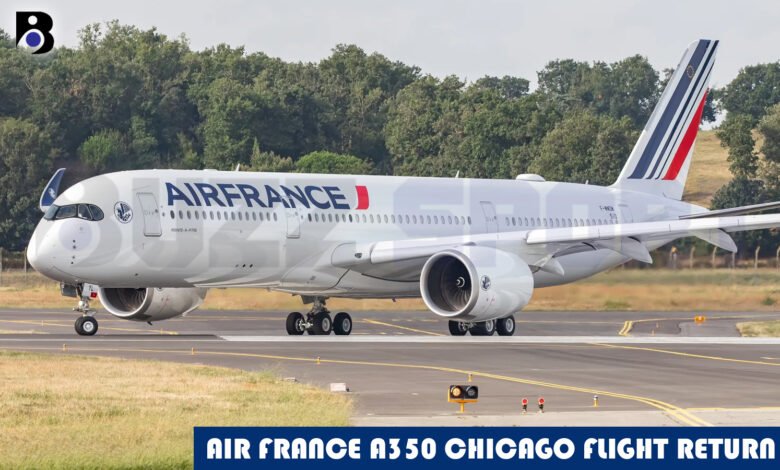
Imagine you are sitting on a plane to Chicago. You have eaten your meal, watched a movie, and you are ready to land. Then the pilot turns the plane around and flies you back to the place where you started.
That is what happened to the passengers of an Air France Airbus A350 in June 2025. The story spread fast online, and many people still search for it today. In this article, I explain what happened, what Air France said, what is only a report, and what you can learn from it if you fly across the Atlantic.
Quick Facts About the Air France A350 Chicago Flight Return
| Detail | Information |
|---|---|
| Flight number | AF136 |
| Aircraft | Airbus A350-900 |
| Route | Paris Charles de Gaulle (CDG) to Chicago O’Hare (ORD) |
| Date | Saturday, June 28, 2025 |
| Departure from Paris | About 12:49 local time |
| Turn back | About 16:30 local time |
| Time in the air | 6 hours and 37 minutes |
| Landing | Safely back at Paris CDG, runway 27R |
| Reason from Air France | “Operational reasons” |
| Reported reason | No landing clearance at Chicago O’Hare |
| Replacement flight | AF4080 on June 29, 2025, at 14:20 |
What Happened on Flight AF136?
Flight AF136 is a normal daily service between Paris and Chicago. On a regular day, the trip takes about nine hours. According to flight tracking data reported by AviationA2Z, the Airbus A350-900 took off from Paris on June 28, 2025, at about 12:49 local time. It climbed to 38,000 feet and followed a northern route over the United Kingdom and out over the Atlantic Ocean.
Around 16:30 local time, the crew decided to go back to France. AviationA2Z reported that the plane was between Iceland and Greenland at that moment. The plane then flew all the way back and landed safely in Paris. In total, the plane spent 6 hours and 37 minutes in the air and ended up where it began.
One relative of a passenger wrote on social media that the plane had turned around with about four hours left to Chicago. That post helped the story spread, and aviation news sites picked it up soon after.
Nobody was hurt, and the landing was normal. This was not an emergency landing. It was a long and tiring trip that went nowhere.
Why Did the Plane Turn Back?
This is the main question, and the honest answer has two parts: what is confirmed and what is only reported.
What Air France Said
Air France confirmed that the flight returned to Paris for “operational reasons.” That is all the airline said. It did not give more details. “Operational reasons” is a wide term. Airlines use it for many things, such as crew rules, aircraft problems, airport limits, or paperwork.
What Was Reported
According to AIRLIVE, a passenger told the news desk that the plane did not get landing permission at Chicago O’Hare. AviationA2Z, local news sites in the United States, and several other outlets repeated this report. Most of them used careful words like “reportedly.”
One website, VisaVerge, tried to explain the idea. It said that flights coming into the United States need landing permission from US border officials in advance, and that the permission can be cancelled if the plane does not arrive within a set time window. The same article also said it was not clear what went wrong after the plane had already left Paris. So this is a possible explanation and not a confirmed fact.
Where the Story Is Not Clear
A few things do not match across the sources:
- How far the plane flew before turning back. Some reports say the plane was in the middle of the Atlantic. Some readers on FlightAware said that flight tracking showed the turn happened about two hours after takeoff, not near the halfway point. Because the plane left the gate at 12:49 and the turn was at 16:30, the time between them is more than three and a half hours. This is a good reminder that online stories often mix up small details.
- Who denied the clearance. Some readers said Chicago air traffic controllers would not have been the ones involved at that point in the flight. They said another air traffic control center handles planes over the ocean. The word “clearance” can mean different things, such as air traffic permission or landing approval.
- The real cause. Air France never explained it, so nobody outside the airline can say for sure.
If you write or share this story, the safest way is to say the cause is “reported, not confirmed.”
What Is “Landing Clearance,” and Why Does It Matter?
Most people think of clearance as a pilot hearing “you can land now” from the tower. But there is more to it for international flights.
A plane that flies into another country needs several approvals. These can include permission for the airline and the aircraft type, passenger and crew information sent in advance, and approval from border and security teams. If one of these is missing or wrong, the plane cannot just land and fix it later.
A real case from the same month shows how this can go wrong. On June 2, 2025, an American Airlines flight from Philadelphia to Naples was changed to a Boeing 787-9 at the last minute. During the descent, the crew found out that this version of the plane was not approved for Naples airport. The flight landed in Rome instead. AviationA2Z covered both stories together because they show the same lesson: aircraft, airports, and paperwork must all match.
This does not prove that the Air France flight had the same kind of problem. It only shows that a mistake in approvals can make a flight change plans, even when the plane itself is fine.
What Happened to the Passengers?
According to AviationA2Z, Air France arranged overnight hotel rooms for the people on board and put them on a new flight. The new flight, AF4080, left Paris for Chicago on Sunday, June 29, at 14:20 local time. Staff at the airport helped the passengers with the changes.
So most travelers reached Chicago about one day later than planned. That is a long delay, especially for people who had hotels, meetings, weddings, or connecting flights in the United States.
Why Do Planes Turn Back in General?
An Air France A350 Chicago flight return is rare, but turn backs happen across the world. Here are the most common reasons:
- Technical problems. A warning light, a system fault, or a part that does not work well can lead the crew to return, even when the problem is small.
- Medical emergencies. If a passenger or crew member is very sick, the pilot may land at the nearest good airport.
- Bad weather. Storms at the destination or on the route can force a change.
- Airport problems. A closed runway, a power failure, or a security event can stop landings.
- Paperwork and permissions. As we saw above, a missing approval can also stop a flight.
- Security issues. A threat or a passenger who causes trouble can lead to a return.
A turn back can look scary on a flight tracker, but it usually means the crew chose the safest and most practical option. Pilots follow strict rules, and returning is often better than risking a bigger problem later.
A Short Look at the Airbus A350
The Airbus A350 is a modern twin engine plane built for long trips. Air France uses the A350-900 on many routes to the United States. According to Trip.com data, many of these planes carry about 324 seats. Airlines like it because it is quiet, uses less fuel than older planes, and is comfortable for long flights.
A plane type being modern does not mean that nothing can ever go wrong. But it also means that the A350 itself was not blamed in the reports about AF136. The reports pointed to landing permission, not to a broken plane.
Air France and the Chicago Route
Chicago is an important city for Air France. The airline flies between Paris Charles de Gaulle and Chicago O’Hare every day. According to TravelPulse, Air France planned to fly up to seven times a week between the two airports with the A350 in winter 2025. The same article reported that the airline opened a new lounge at O’Hare for its passengers.
Air France is not alone on this route. Flight route data shows that American Airlines and United also fly non stop between Paris and Chicago. The flight is about 4,164 miles (6,700 km) long.
With so many flights each day, one unusual turn back does not say much about the whole route. Still, it got a lot of attention because the flight was in the air for almost seven hours and ended in the same place.
Tips for Travelers on Long Flights
You cannot control what the airline or the airport does. But you can get ready for a surprise. Here are some simple ideas:
- Keep important things in your carry on bag. Medicine, chargers, a change of clothes, and travel papers should be with you.
- Save the airline’s contact details. Keep the app, the phone number, and your booking number easy to find.
- Check your travel insurance. Some plans pay for hotels, meals, and lost plans when a flight is delayed a lot.
- Keep your receipts. If you pay for food, a taxi, or a hotel, you may be able to ask for the money back.
- Stay calm and be polite. Airline staff are busy after a turn back. Clear and kind words often help you get faster help.
- Ask about your rights. Rules depend on where you fly from and which airline you use.
What About Passenger Rights?
Rules about delays are different in each country. For flights that leave the European Union, such as a flight from Paris, European passenger rules can apply. These rules may give you the right to care, such as meals and a hotel, and sometimes money for long delays. But whether you can get money often depends on the cause of the delay.
I am not a lawyer, and this is general information, not legal advice. If your flight is turned back, ask the airline what it offers and read its official rules. You can also contact a passenger rights group in your country.
Final Thoughts
The Air France A350 Chicago flight return of June 28, 2025, was a long trip with no happy ending for the passengers, but it ended safely. Flight AF136 flew for 6 hours and 37 minutes, turned around, and landed in Paris. Air France said the reason was “operational.” Several reports said the plane did not have landing permission for Chicago O’Hare.
The most useful lesson is to be careful with fast news. Some details changed from one website to another, and the airline never gave a full explanation. If you want the truth about a flight like this, look for the facts that appear in many trusted sources, and be ready to say “we do not know yet” about the rest.
Frequently Asked Questions
Why did the Air France A350 return to Paris instead of landing in Chicago?
Air France said it turned back for “operational reasons.” Passengers and aviation news sites reported that the flight did not have landing clearance at Chicago O’Hare. The airline has not given a full explanation, so the exact cause is reported but not confirmed.
Was the Air France flight AF136 return an emergency?
No emergency was reported. The plane flew back to Paris and landed safely on runway 27R after 6 hours and 37 minutes in the air. Air France arranged a hotel for the night and a new flight the next day for the passengers.
Did the passengers still get to Chicago?
Yes. Air France put the passengers on replacement flight AF4080. It left Paris on June 29, 2025, at 14:20 local time, which was about one day after the first plan.