The Los Angeles Chargers and the Pittsburgh Steelers met at SoFi Stadium on November 9, 2025, in a Sunday Night Football game that many fans were excited to watch. The Chargers won the game 25 to 10, and the final score does not tell the whole story. If you look closely at the player stats, you can see exactly how Los Angeles controlled the game from start to finish and why Pittsburgh struggled to keep up.
Game Overview
The Chargers came into this game with a 6 and 3 record, and Pittsburgh arrived with a 5 and 3 record. Both teams needed a win to stay strong in a tight AFC race. Los Angeles used a mix of smart passing, steady running, and a tough defense to take control early and never let go.
Pittsburgh, led by veteran quarterback Aaron Rodgers, had trouble moving the ball for most of the game. The Steelers did not score a touchdown until the fourth quarter, when it was already too late to change the result. By the end of the night, the Chargers had improved to 7 and 3, while the Steelers dropped to 5 and 4.
Time of possession also played a big role. The Chargers held the ball for about 37 minutes and 35 seconds, while the Steelers had it for only about 22 minutes and 25 seconds. This means Los Angeles controlled the pace of the game and kept their defense fresh, while Pittsburgh’s offense could never find a steady rhythm.
Quarterback Stats: Herbert vs Rodgers
The quarterback matchup was one of the most talked about parts of this game, since Justin Herbert and Aaron Rodgers are both well known names in the NFL.
Justin Herbert had a smart and steady game for the Chargers. He completed 20 of his 33 passing attempts for 220 yards and one touchdown. He did not throw any interceptions. His passer rating for the night was 90.5, which shows he made good decisions and avoided costly mistakes.
Aaron Rodgers had a much tougher night. He completed 16 of 31 passes for 161 yards. He threw one touchdown, but he also threw two interceptions. His passer rating was only 50.6. Rodgers was also sacked three times during the game, which shows the pressure that Pittsburgh’s offensive line allowed him to face. Rodgers later admitted that he did not play well and that his team struggled badly on third down all night.
This difference between the two quarterbacks explains a lot about why the Chargers won so clearly. Herbert protected the ball and made steady plays, while Rodgers made mistakes at important moments.
Running Back Performances
The running game also showed a clear difference between the two teams.
Kimani Vidal was the standout rusher for the Chargers. He carried the ball 25 times for 95 yards and scored one rushing touchdown. This was a career high in carries for Vidal, and his performance helped the Chargers control the clock and wear down the Pittsburgh defense. Advanced stats show Vidal gained about 27 yards before contact and 68 yards after contact, plus he had three runs of 10 yards or more.
For Pittsburgh, Jaylen Warren led the way with 14 carries for 70 yards, which is an average of 5.0 yards per carry. This was actually a solid number, but Pittsburgh did not use the running game enough, and Warren did not get as many chances as Vidal did. Warren’s advanced numbers show 20 yards before contact and 50 yards after contact, along with one broken tackle.
Najee Harris also saw some carries for the Steelers, but the running game as a whole could not keep up with the pace the Chargers set on the ground.
Wide Receivers and Tight Ends
When it comes to catching passes, Ladd McConkey was the top performer of the entire game. He caught 4 passes for 107 yards and one touchdown. This was a season high for him, beating his earlier best of 100 yards. His 58 yard catch in the third quarter also helped set up a Chargers touchdown, which was a turning point in the game.
Quentin Johnston also added to the passing game for the Chargers, catching 5 passes for 42 yards.
On the Pittsburgh side, Pat Freiermuth was a steady target for Rodgers. He caught 3 passes for 33 yards. Roman Wilson caught the Steelers’ only touchdown of the game, a 27 yard score late in the fourth quarter, but by then the Chargers already had a big lead.
Overall, the receiving stats show that the Chargers had more explosive plays, especially the long completion to McConkey, while the Steelers’ passing game struggled to find any rhythm until it was too late.
Defense and Turnovers
Defense was the true difference maker in this game, and the stats prove it clearly.
The Chargers defense forced three turnovers and did not turn the ball over even once. Donte Jackson picked off a pass in the fourth quarter and returned it 21 yards. R.J. Mickens also had an interception in the second quarter, returning it 10 yards. These takeaways stopped Pittsburgh’s drives at key moments and gave the Chargers offense extra chances to score.
The Steelers pass rush was actually strong throughout the game, recording five sacks and nine quarterback hits against Herbert. However, even with all that pressure, Herbert stayed calm and avoided mistakes, which shows how important quarterback decision making can be, even under pressure.
Pittsburgh’s defense also held the Chargers to 221 total yards, which was actually a very good number. This was part of a trend where Pittsburgh’s defense had now held three straight opponents to 221 yards or fewer. The problem for the Steelers was not really their defense. It was the offense’s turnovers and their poor performance on third down, converting only 2 of 11 attempts.
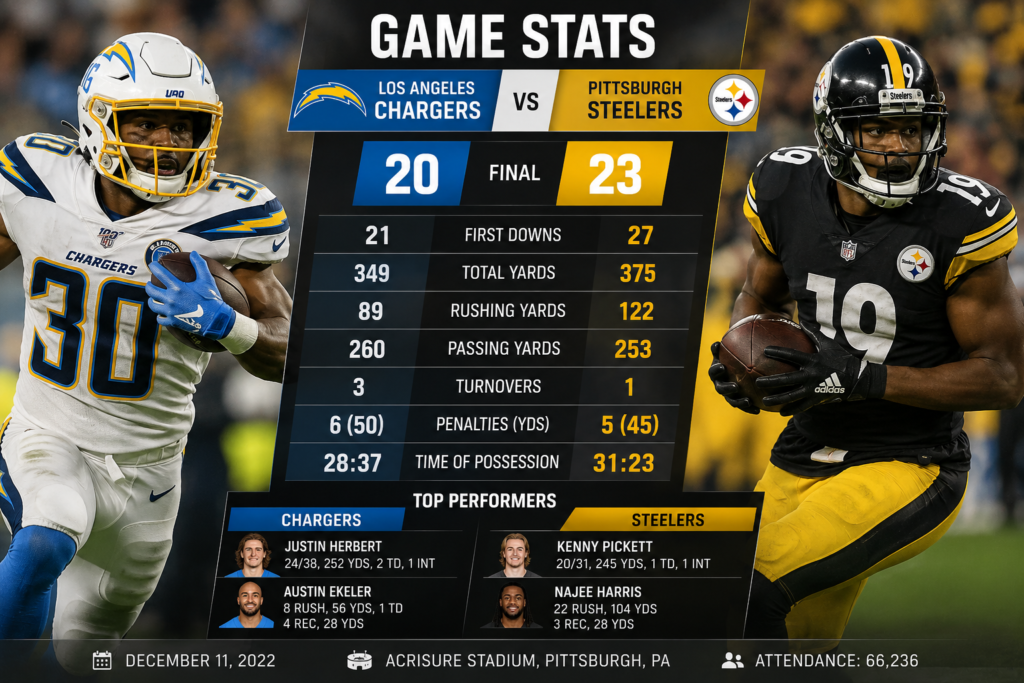
Team Stats Comparison
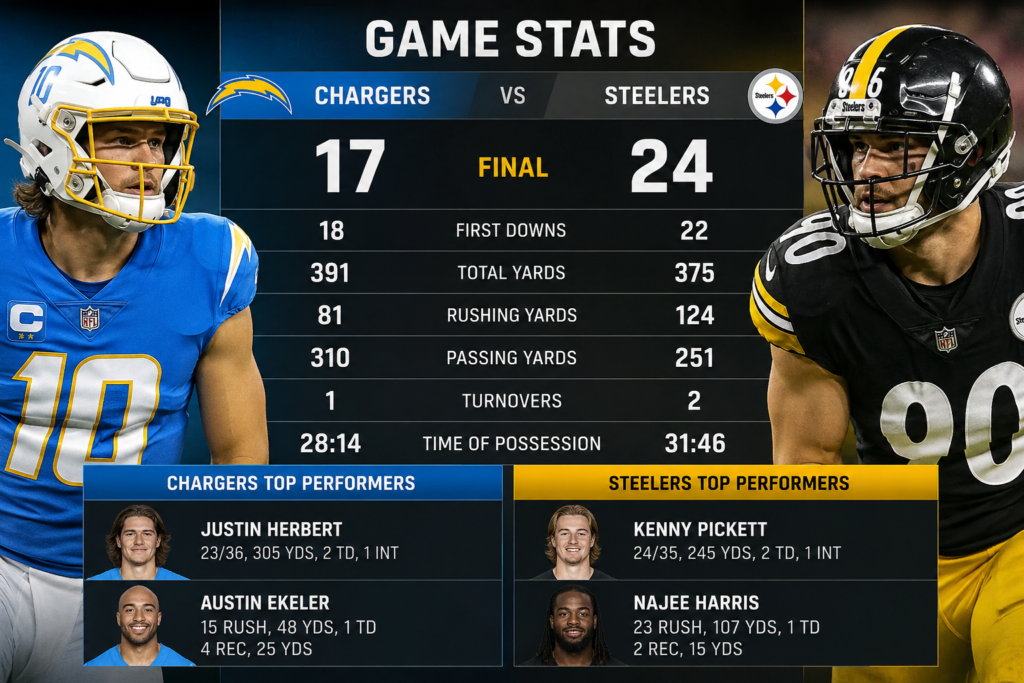
Here is a simple comparison of the two teams’ overall numbers from the game:
- Total yards: Chargers 314, Steelers 221
- Passing yards: Chargers 199, Steelers 148
- Rushing yards: Chargers 115, Steelers 73
- Total plays: Chargers 69, Steelers 50
- Turnovers: Chargers 0, Steelers 3
- Time of possession: Chargers 37 minutes 35 seconds, Steelers 22 minutes 25 seconds
- Third down conversions: Steelers 2 of 11
These numbers show that the Chargers were better in almost every important area. They ran more plays, gained more yards, kept the ball longer, and did not turn it over a single time. Pittsburgh’s biggest problem was the three turnovers and the very poor third down conversion rate, which made it almost impossible for their offense to keep drives alive.
What This Game Means Going Forward
This win moved the Chargers to 7 and 3, keeping them close behind the Denver Broncos in the AFC West standings. Head coach Jim Harbaugh said after the game that he especially liked wins that come from physical effort, heart, and grit, and this game was exactly that kind of win for his team.
For the Steelers, this loss dropped them to 5 and 4 and was their third loss in four games. Aaron Rodgers was honest after the game, saying the team played badly and needs to find a way to be better on third down. Pittsburgh still leads the AFC North, but they will need to clean up their turnover problems if they want to stay on top.
Final Thoughts
When you look at the full player stats from this Chargers vs Steelers game, the story becomes very clear. Justin Herbert played smart and mistake free football, Kimani Vidal had a career night on the ground, and Ladd McConkey delivered the biggest offensive play of the game. On defense, the Chargers forced three turnovers and did not give the ball away even once.
For Pittsburgh, Aaron Rodgers struggled with two interceptions, the offense could not find any rhythm on third down, and those problems were simply too much to overcome, even with a strong pass rush and a defense that limited the Chargers to just 221 total yards.
In the end, the Chargers earned a well deserved 25 to 10 win, and the player stats show exactly why they came out on top.
Frequently Asked Questions
What was the final score of the Chargers vs Steelers game?
The Los Angeles Chargers beat the Pittsburgh Steelers 25 to 10 on November 9, 2025, at SoFi Stadium.
Who was the best player in the Chargers vs Steelers game?
Justin Herbert had a strong and mistake free game for the Chargers, throwing for 220 yards and a touchdown with no interceptions. Kimani Vidal also stood out with 95 rushing yards and a touchdown, and Ladd McConkey had a season high 107 receiving yards with a touchdown.
Why did the Steelers lose to the Chargers?
The Steelers lost mainly because of turnovers and poor third down conversions. Aaron Rodgers threw two interceptions, the team turned the ball over three times in total, and they converted just 2 of 11 third down attempts, which made it very hard to keep drives going.