You are hungry, you want something warm and green, and you type “best tarta de acelga near me” into Google. Then you see a map full of pizza shops and burger places. Sound familiar?
Tarta de acelga is a simple, comforting dish, but it is not on every menu. The good news is that you can find a great slice if you know where to look and what to check. This guide will help you do that. You will also learn what the dish is, where it comes from, how to store leftovers, and how to make a quick version at home.
What Is Tarta de Acelga?
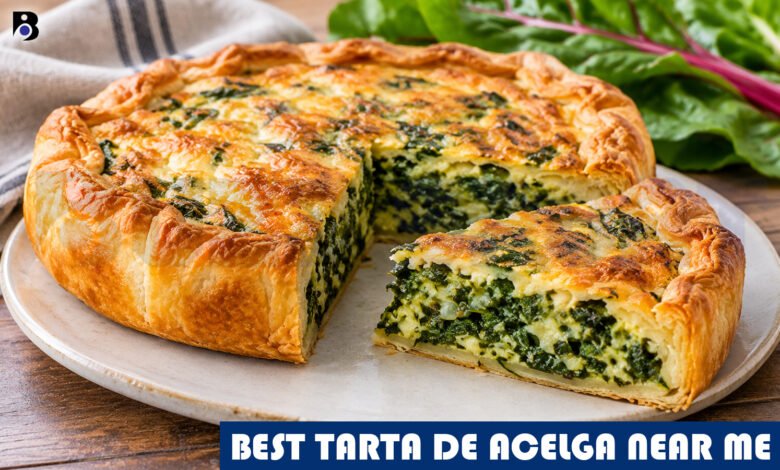
Tarta means tart or pie in Spanish. Acelga means Swiss chard, a leafy green vegetable with soft leaves and thick, colorful stems. So tarta de acelga is a savory Swiss chard pie.
Cooks usually soften the chard with onion, mix it with eggs and cheese, and bake it in a pie crust. Many recipes also add a little nutmeg, salt and pepper. The result is a pie that tastes mild, creamy and a bit earthy. You can eat it hot, warm or cold.
The dish is very popular in Argentina and Uruguay, where it is a normal home meal. A popular recipe from the Argentine site Infobae calls it a nutritious and tasty classic of Argentine cooking. People eat it for lunch, dinner, or as part of a picnic or family meal.
Some names can be confusing, so here is a short list:
- Tarta de acelga: a savory pie with Swiss chard as the main vegetable.
- Tarta de espinaca: the same idea, but made with spinach.
- Tarta pascualina: a version with whole eggs baked inside the filling, often eaten around Easter.
- Swiss chard pie or chard tart: the English names you may see on a menu.
Cooks and shops use these names in different ways. One bakery may call its chard pie “pascualina”, and another may not. That is why it helps to search with more than one name. We will come back to this in the tips.
A Short Look at Where It Comes From
Tarta de acelga is closely linked to an Italian pie called torta pasqualina. This pie comes from Liguria, the region around the city of Genoa. The name comes from Pasqua, the Italian word for Easter, because people traditionally make it for the Easter season. A cooking class page from Genoa says the pie is always on Genoese tables at Easter, but that locals also make it all year.
The pie is old. The Italian site Italoamericano says a writer from the 1500s, Ortensio Lando, already wrote about it. The same article shares a well-known legend: the best Genoese cooks made the pie with 33 thin layers of pastry, one for each year of the life of Christ.
When many Italians moved to South America, they took their recipes with them. In Argentina, Uruguay and nearby countries, the pie became simpler. Cooks often use two crusts instead of many thin layers, and they often use chard because it is easy to find and cheap. Today, many people in those countries see the tart as their own food.
This history helps you in a practical way. If you want a good tarta de acelga, look for places connected to Argentine, Uruguayan, Italian or wider Latin American cooking. These cooks know the dish well.
Why People Love It
There are a few simple reasons.
First, it is filling but not heavy. You get vegetables, eggs, cheese and pastry in one slice. Second, it is flexible. You can eat it with a salad for a light meal, or take a slice to work for lunch. Third, it tastes good at different temperatures, so it is easy to carry and share.
It is also a good choice for people who want more vegetables. Swiss chard is a nutritious leafy green. Healthline explains that it belongs to the same plant family as beets and spinach, and that it is a very good source of vitamin K. Other sources, such as Medical News Today, add that it has vitamin A, vitamin C, magnesium and fiber.
One small health note: because chard has a lot of vitamin K, people who take blood thinners such as warfarin should keep their chard intake steady. Healthline and Medical News Today both say this. If this is you, ask your doctor before you change your diet.
Remember that a pie also has crust, cheese and eggs, so it is not a diet food. It is a tasty, balanced home-style meal, and that is what most people want from it.
7 Easy Tips to Find the Best Tarta de Acelga Near You
Tip 1: Search with more than one name
If you only type “tarta de acelga”, you may miss good places. Try these searches too:
- tarta pascualina near me
- Swiss chard pie near me
- spinach and chard tart bakery
- Argentine bakery near me
- Latin American bakery near me
A small shop may sell the pie but use a different name. One food guide for this dish makes a similar point: searching only for the exact phrase “best tarta de acelga near me” often does not give helpful results. It suggests looking for Argentine restaurants, Latin American restaurants and bakeries in your area instead. That advice works well because the shops that know the dish are easier to find than the dish itself.
Tip 2: Start with the right kind of place
Not every restaurant makes this pie well. These places are your best bet:
- Argentine and Uruguayan bakeries and cafés. The pie is a normal item for them.
- Latin American restaurants and delis. They often sell savory tarts by the slice or the whole pie.
- Italian bakeries. Some sell torta pasqualina or similar vegetable pies.
- Specialty food markets. Some sell fresh or frozen savory tarts made nearby.
- Home cooks and small food businesses. In some cities, people sell homemade pies through local groups or food markets.
Big cities with large Argentine, Uruguayan or Latin American communities usually have more choices. If you live in a small town, you may need to drive a bit, or you may have better luck with the home-cooking route in Tip 7.
Tip 3: Use Google Maps in a smart way
Google Maps is a great tool, but only if you use it well. Do not stop at the star rating. Follow these steps:
- Search for a type of place, for example “Argentine bakery”.
- Open a few shops with good ratings.
- Use the search box inside the reviews and type “tarta”, “acelga” or “pascualina”.
- Read what people say about the pie itself. A review that only says “great food” does not help you much.
- Look at the photos from customers. You can often see the crust and the filling.
- Check that the reviews are recent. Menus change.
If a shop has lots of reviews for its empanadas but none for tarta, the pie may be rare or not as good. A shop with a few detailed comments about its chard pie is a better sign.
Tip 4: Call before you go
This step saves time. Many shops make their tarta in small batches, and a slice can sell out by the afternoon. A short phone call can answer these questions:
- Do you have tarta de acelga today?
- Is it made here, or do you buy it from another company?
- Do you sell it by the slice or only as a whole pie?
- What time is it usually ready?
- Can I order one for tomorrow?
Asking “is it made here?” is helpful. A fresh pie from a local kitchen often tastes better than a reheated frozen one, although a good frozen pie can still be fine.
Tip 5: Look at the slice before you buy
A good tarta de acelga has some clear signs. Check for these:
- A golden crust. It should look baked, not pale or greasy.
- A firm filling. When the slice is cut, it should hold its shape. A runny middle can mean the chard was not drained well.
- No big puddle at the bottom. Chard holds a lot of water. If cooks do not squeeze it well, the base turns soggy. Several cooking guides warn about this.
- Green color with some cheese and egg. The inside should look bright and fresh, not gray or dry.
- A pleasant smell. You should smell baked pastry, onion and cheese, not anything sour.
If the shop lets you see the pie before you pay, take a quick look. If you order online, check the photos.
Tip 6: Ask about the ingredients
This is useful for taste and for health. You can ask:
- What cheese is inside? Common choices are ricotta, mozzarella-style cheese, cream cheese and grated hard cheese.
- Is there onion, garlic or nutmeg?
- Is the crust made with butter, oil or another fat?
- Is there meat or chicken in it? Some pies add chicken, so this matters for vegetarians.
- Is it safe for my diet? A tarta usually has wheat, eggs and milk. If you have an allergy, say so clearly and ask the staff to check.
Do not be shy. Good bakers like to talk about their food, and their answers will tell you a lot about the pie.
Tip 7: Compare, then choose your favorite
Your first slice may not be your favorite. Buy one slice from two or three places and compare them. Think about the crust, the filling and the flavor. Does the chard taste fresh? Is the cheese too salty? Does the crust stay crisp? Write a short note on your phone if you like.
If you cannot find a good one close to you, you can make your own. A home version is not hard, and it lets you control the salt, the cheese and the crust. There is a simple method at the end of this guide.
What Does a Great Slice Taste Like?
Here is a simple way to judge a tarta de acelga. Think about three things.
The filling. It should taste of chard first. You should also notice a gentle cheese flavor and a soft egg texture. Good cooks often add a little onion, and some add nutmeg. It should not be too salty or oily.
The crust. It can be thin and crisp or soft and buttery, depending on the style. Either is fine, but it should be cooked all the way through. A raw, doughy base is a bad sign.
The balance. The best slices do not hide the vegetable. A heavy hand with cheese can cover the taste of the chard. A great tart tastes like a home-cooked meal, not like a fast-food snack.
What to Eat With It
Tarta de acelga is easy to serve. Here are some ideas:
- A fresh salad with tomato, lettuce and lemon juice
- A bowl of soup on a cold day
- A few slices of fresh bread
- Roasted potatoes or rice
- A cup of tea or a cold drink at lunch
Some people also like it with a small spoon of yogurt or a squeeze of lemon on the side. Try what you enjoy.
How to Store and Reheat Leftovers Safely
If you buy a whole pie, you may have leftovers. Because the pie has eggs and dairy, store it with care. The advice below comes from food safety guides, including those that follow the United States Department of Agriculture (USDA).
- Cool it, then refrigerate it. Put leftovers in the fridge within two hours. If the room is hot, above 90°F (32°C), do it within one hour. Mayo Clinic and university food safety guides give this advice.
- Keep it covered. Use an airtight container or wrap the pie well.
- Eat it in 3 to 4 days. Most cooked leftovers, including egg dishes, are best used within this time if the fridge is at 40°F (4°C) or colder.
- Freeze if you need more time. Frozen leftovers keep their best quality for about 3 to 4 months, and egg dishes are often listed at 2 to 3 months. Slice the pie first, so you can take out one piece at a time.
- Reheat well. Heat leftovers until they reach 165°F (74°C). A food thermometer is the easiest way to check. You can use an oven, which keeps the crust crisp, or a microwave, which is faster but can make the crust soft.
When in doubt, throw it out. It is not worth getting sick for one slice of pie.
A Simple Home Version
If you want to try cooking it yourself, here is an easy recipe. It is based on common Argentine recipes, such as the one from Infobae, and you can change it to fit your taste. It makes about six slices.
You need:
- 2 ready-made pie crusts (or make your own dough)
- 1 large bunch of Swiss chard
- 1 medium onion, chopped
- 2 cloves of garlic, chopped
- 3 eggs
- About 200 ml of cream or milk
- About 100 g of grated cheese
- Salt, pepper and a pinch of nutmeg
- A little olive oil
Steps:
- Heat your oven to a medium-high temperature, around 180°C (350°F).
- Wash the chard well. Cut off the thick stems and chop the leaves. You can cook the stems too, if you like. Cut them small.
- Boil the leaves in salted water for about five minutes. Drain them and let them cool.
- Squeeze out the water. This is the most important step. Press the chard in a clean towel or a strainer until it is quite dry. This stops the pie from getting soggy.
- Cook the onion and garlic in olive oil until soft.
- Mix the chard, onion, garlic, eggs, cream and cheese in a bowl. Add salt, pepper and nutmeg.
- Put one crust in a pie pan. Pour in the filling. Cover with the second crust and press the edges together. Cut a few small holes in the top.
- Bake for about 30 to 40 minutes, until the top is golden.
- Let the pie rest for about 15 minutes before you cut it. The filling will set and the slices will look neat.
Baking times change from oven to oven, so check the pie near the end.
Common Mistakes to Avoid
- Choosing by distance only. The closest shop is not always the best one.
- Trusting the star rating alone. Read what people say about the pie.
- Skipping the phone call. A trip for nothing is no fun.
- Not asking about allergies. The pie usually has eggs, milk and wheat.
- Leaving the pie out too long. Put leftovers in the fridge in good time.
- Forgetting that names change. If “acelga” gives nothing, try “pascualina” or “Swiss chard pie”.
Final Thoughts
Finding the best tarta de acelga near you takes a little detective work, but it is worth it. Search with different names, look at Argentine, Uruguayan, Italian and Latin American shops, read reviews that talk about the pie, call before you go, and check the slice with your own eyes. If nothing is close, you can always bake your own with a few simple ingredients.
This humble pie has a long story, from the kitchens of Genoa to the family tables of South America. When you find a good slice, you get a taste of that story. Enjoy it.
Frequently Asked Questions
What is the difference between tarta de acelga and tarta pascualina?
They are close cousins. Tarta de acelga is a savory pie with Swiss chard as the main filling. Tarta pascualina comes from the Italian torta pasqualina, and it usually has whole eggs baked inside the filling, along with chard or spinach and a soft cheese such as ricotta. It is linked to Easter, but people eat it all year. In practice, shops and cooks use the names in different ways, so it is a good idea to ask what is inside.
Is tarta de acelga healthy?
It can be a good part of a balanced diet. Swiss chard is a leafy green that is very high in vitamin K and also has vitamin A, vitamin C, magnesium and fiber, according to Healthline and Medical News Today. The pie also has crust, cheese and eggs, so it adds fat and calories. Eat a slice with a salad for a lighter meal. If you take a blood thinner such as warfarin, talk to your doctor, because a big change in vitamin K can affect how the medicine works.
Can I freeze tarta de acelga?
Yes. Cool the pie, cut it into slices, wrap each one well and freeze it. Food safety guides say that frozen leftovers keep their best quality for about 3 to 4 months, and egg dishes are often listed at 2 to 3 months. To eat it, thaw it in the fridge and reheat it until it reaches 165°F (74°C). You can also reheat it from frozen, but it takes longer.