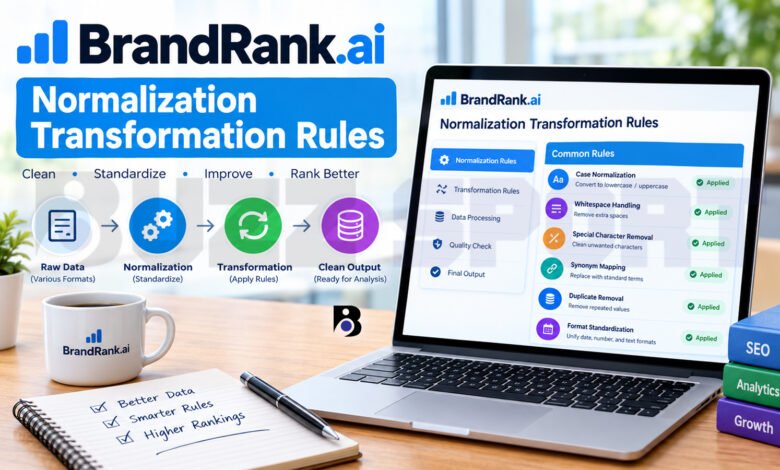
If you search for “BrandRank.ai normalization transformation rules”, you will find many articles. Some of them sound very sure. They talk about a special rulebook, a secret method, even a set of steps. But when you look for this rulebook on the BrandRank.AI website, you will not find it.
So what is going on? Is this a real thing, or just a phrase that got copied from one blog to another?
In this guide, we look at what is true, what is not, and what you can learn from it. We use the company’s own website and press releases, plus simple data ideas that anyone can understand. By the end, you will know what these words mean, what BrandRank.AI really does, and how to use the good ideas for your own brand.
The Short Answer
Here is the quick version:
- BrandRank.AI is real. It is a company that checks how AI tools talk about brands.
- “Normalization transformation rules” is not an official BrandRank.AI product. We found no public page from the company that uses this name or lists such rules.
- The ideas behind the phrase are real. Normalization and transformation are normal data tasks. They help computers understand that many different spellings point to one brand.
So the honest answer to “Real or Myth?” is: a bit of both. The company is real. The ideas are real. But the exact rulebook people describe online is not something BrandRank.AI has published.
What Is BrandRank.AI?
BrandRank.AI is an AI brand analytics company. According to its website, it tracks whether tools like ChatGPT, Gemini, Perplexity, Grok, Claude, Meta AI and DeepSeek recommend a brand. It checks important buying questions every day across seven AI answer engines.
The company says it works with large global brands. Its site lists names such as Nestlé and P&G as clients.
The main idea is simple. In the past, a shopper searched on Google and saw ten links. Now many people ask an AI tool one question and get one answer. That answer may name your brand, or it may name your competitor. BrandRank.AI tries to show which one it is, why it happens, and what a brand can fix.
The Three Scores
On its website, BrandRank.AI explains that it measures a brand in three main areas:
- AI Search Visibility. Do you show up when it matters? This looks at how often your brand appears in answers and how you compare with others in your category.
- Brand Vulnerability. What does AI say about you? This looks at trust, product claims, accuracy and the tone of the answers.
- Content Readiness. Is your website ready for AI search? This looks at how easy your content is for AI tools to reach and read, and how deep your content and structured data are.
The company also describes a Brand Risk Monitor. It watches AI answers and warns a team when an answer may hurt the brand.
Another key term on the site is Recommendation Share. The company explains it like this: visibility shows how often you appear in an answer, while Recommendation Share shows how often you are the brand the answer actually names.
None of these pages use the words “normalization transformation rules.”
The Real Framework: Brand Health and Trust
BrandRank.AI does have a named framework. In 2026, Burke, Inc., a consumer insights company, announced a partnership with BrandRank.AI. The press release says the company’s Brand Health and Trust framework gives brands a clear view of where they stand in the AI answer world.
The first tool from the partnership is called BRAND ANSWER. It is a diagnostic. In simple words, it shows:
- how AI answers describe a brand,
- where the brand is missing from important customer questions,
- and how the brand compares with its competitors in AI answers.
Burke also shared a survey result in the announcement. It said 47% of consumers worry about how accurate and fair AI answers are. That is a big reason brands want to check what AI says about them.
So if you see a blog post that says “BrandRank.AI normalization transformation rules are a 7-step method”, you should be careful. The named framework in the public materials is Brand Health and Trust, not a normalization rulebook.
So Why Does the Phrase Exist?
We cannot say for sure who first wrote it. But we can make a smart guess about why it spread.
BrandRank.AI is a new company in a hot area. Many people search for it. Blog writers saw that “normalization” and “transformation” are popular data words, and they joined them with the company name. Then other writers copied the same idea. After a while, it looked like a real thing, because so many pages repeated it.
This happens often online. When many pages repeat the same claim, readers think it must be true. But repeating a claim does not make it true. The best check is simple: does the company itself say it? In this case, the answer is no.
That does not mean the topic is useless. The words in the phrase describe real work that matters for brands in AI search. Let us look at them one by one.
What Does Normalization Mean?
Normalization means making things consistent. In data work, it means changing different versions of the same thing into one standard version, so a computer can compare and match them.
Think about how people write a brand name:
| What people write | Standard version |
|---|---|
| BrandRank AI | BrandRank.AI |
| Brand Rank | BrandRank.AI |
| brandrank.ai | BrandRank.AI |
| BRANDRANK.AI | BrandRank.AI |
A person knows these all mean the same company. A computer might not. If the data is messy, the system may treat them as four different brands. Then the numbers get split, and reports become wrong.
Common Normalization Rules
Data teams often use a short list of rules. Guides on brand name normalization usually include these:
- Fix the letter case. Make “NIKE”, “Nike” and “nike” match.
- Clean up spaces. Remove extra spaces at the start, end or middle of a name.
- Handle punctuation. Decide how to treat dots, commas, dashes and symbols.
- Handle legal endings. Words like “Inc.” or “Ltd.” can add noise when you match company names.
- Use one text standard. Make sure special letters and accents are stored in one consistent way.
One more point from these guides is very useful: the order of the rules matters. For example, you should clean the spaces before you try to match names. Each step depends on the clean result of the step before it.
What Does Transformation Mean?
Transformation is a bigger word. It means changing data into a shape that is more useful. Normalization is one kind of transformation, but not the only one.
Here are a few simple examples:
- Turning a messy text mention into a clean entry in a table.
- Putting scores from different sources on the same scale, so they can be compared fairly.
- Grouping many small mentions into one total for a brand.
Why does the scale matter? Imagine one tool gives scores from 1 to 10, and another gives scores from 1 to 100. If you add them without changing them, the second tool will control the result. A transformation puts both on the same scale first.
This is general data science. It is not a secret method owned by one company. Any team that builds a serious brand tracking system has to do some version of it.
How These Ideas Connect to AI Visibility
Now let us connect the dots. Why would normalization matter for a brand that wants to show up in AI answers?
AI tools learn from a lot of text. They also look for matching signals across many sources. When your brand is written in many different ways on your website, your social pages, your listings and other sites, the signals can look weak or mixed. When your brand is written the same way everywhere, the signals are clearer.
Here are some places where consistency helps:
- Your name. Use one official spelling on every page and profile.
- Your description. Use one short, clear line that says what you do.
- Your product names. Do not change the names from page to page.
- Your structured data. Add schema markup so machines can read your brand details clearly.
- Your facts. Keep prices, locations, dates and claims the same everywhere.
BrandRank.AI itself talks about content readiness, structured data and third party proof as parts of winning AI answers. Its readiness score looks at three factors: content liquidity, search capital and algorithmic anchors. So the general idea of “clean, clear, consistent brand data” fits well with what the company says matters.
But be careful with one thing. No one outside the AI companies knows exactly how ChatGPT, Gemini or any other tool picks a brand. Consistency is a smart habit and it will likely help. It is not a guaranteed trick.
A Simple Plan You Can Use Today
You do not need a special tool to start. Here is a plan any small team can follow.
Step 1: Collect Your Brand Names
Make a list of all the ways your brand name appears. Check your website, social media, online directories, press pages and old blog posts. You may be surprised how many versions you find.
Step 2: Choose One Standard
Pick one official name. Decide the exact spelling, capital letters and spacing. Write it down in a short style guide.
Step 3: Fix Your Own Pages First
Update the pages you control. This includes titles, headings, image text, about pages and social profiles. This part is in your hands, so start here.
Step 4: Add Structured Data
Use schema markup on your site so machines can read your brand name, logo, links and description. Use the same details you wrote in your style guide.
Step 5: Ask the AI Tools
Ask ChatGPT, Gemini, Perplexity and others questions your customers might ask. Write down which brands appear and what they say about you. Do this again every month. If you want deeper tracking, a platform like BrandRank.AI is built for this job.
Step 6: Fix Wrong Facts
If an AI answer has old or false information, look for the source of the mistake. It might be an old page, a wrong listing or a post on another site. Fix what you can, and ask other sites to update their pages.
Step 7: Keep a Playbook
Write your rules in one shared document. Add exceptions, like product names that look unusual on purpose. Update it a few times a year.
Common Mistakes to Avoid
Even a good plan can go wrong. Watch out for these problems:
- Cleaning too much. If your rules remove words that are part of the real brand name, you may break it. A good rule list has a place for exceptions.
- Merging different brands. Two companies can have similar names. Do not combine them just because they look alike.
- Fixing it once and forgetting it. New pages, new tools and new team members bring new spellings. Check on a regular basis.
- Trusting claims with no source. If a blog says a company has a secret rulebook, look for proof on the company’s own site.
- Expecting quick magic. Cleaner data helps, but AI answers change often. Treat it as ongoing work.
How to Check a Claim Like This
The “BrandRank.ai normalization transformation rules” story is a good lesson for any topic. Here are four quick checks you can use every time:
- Look at the official site. Search the company’s pages, FAQ and press room for the exact phrase.
- Find the original source. Many blogs copy each other. Look for a first source that is not a copy.
- Check the date and the author. Is there a real person or company behind the claim?
- Compare more than one source. If only low quality pages say it, be careful.
Using these checks protects your readers, your customers and your own reputation.
Final Thoughts
Let us go back to our question: are BrandRank.ai normalization transformation rules real or a myth?
The company is real, and it does useful work in AI brand tracking. Normalization and transformation are real data skills that help systems match brand names and compare scores fairly. But we found no official BrandRank.AI rulebook with this name. The phrase looks like a mix of a real company and real data ideas, repeated by many blogs.
The good news is that you can still learn something useful. Keep your brand name, facts and data consistent. Make your website easy for machines to read. Check what AI tools say about you on a regular basis. These habits are simple, and they make sense no matter which tool you use.
Frequently Asked Questions
Is “BrandRank.ai normalization transformation rules” an official BrandRank.AI product?
No. We found no page on the BrandRank.AI website, in its FAQ or in its press materials that uses this name or lists such rules. The framework the company names publicly is Brand Health and Trust, which it built with Burke, Inc., along with a tool called BRAND ANSWER. The phrase you see on many blogs is better seen as a short way to talk about cleaning and organizing brand data.
What is the difference between normalization and transformation?
Normalization means making different versions of the same thing look the same. For example, “Brand Rank”, “BrandRank AI” and “brandrank.ai” all become one standard name. Transformation is a wider word. It means changing data into a more useful shape, such as putting scores on the same scale or turning raw text into clean table entries. Normalization is one type of transformation.
Can consistent brand data really help my brand show up in AI answers?
It can help, but nobody can promise a result. AI tools read signals from many sources, and clear, matching information makes those signals easier to understand. A consistent name, accurate facts and clean structured data are all good habits. But AI tools do not share how they pick brands, so treat these steps as smart preparation and not as a guaranteed trick.