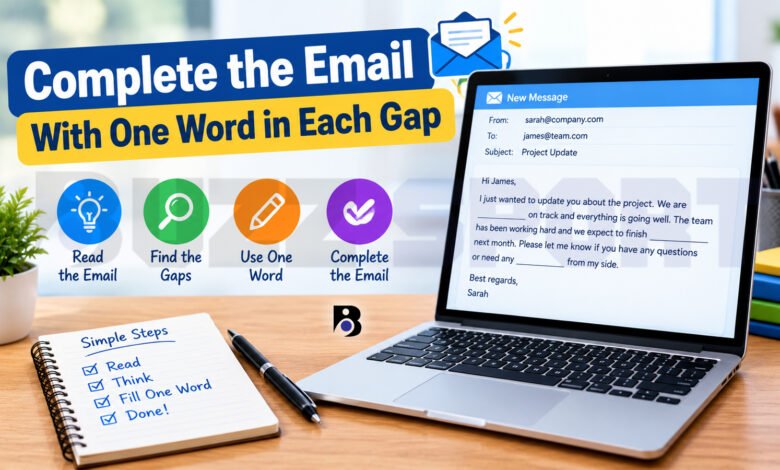
Have you ever seen an English test with an email that has empty spaces in it? Under the email, you see a short line: “Complete the email with one word in each gap.” Many students feel nervous when they see this task. The good news is that it is easier than it looks. With a clear method and a little practice, you can get most of the answers right.
What Does “Complete the Email With One Word in Each Gap” Mean?
Let us start with the instruction itself. It has three parts:
- Complete the email. The email is not finished. Some words are missing.
- One word. You must write only one word in each empty space.
- In each gap. A gap is an empty space in the text, often shown as a line or a number in brackets.
So your job is to read the email, understand the message, and put the right word in each space. When you finish, the email should sound natural and make sense from the first line to the last.
This type of task is often called a “gap-fill” exercise. In some exams, it is also called an “open cloze” task, because there are no answer choices. You do not choose from A, B, or C. You must think of the word yourself. That is why many students find it harder than a multiple choice question.
Where Do You See This Task?
You can find email gap tasks in many places. The most famous example is the Cambridge English A2 Key exam. In the Reading and Writing paper, Part 5 asks students to complete the gaps in an email using one word. Exam English, a website for exam practice, explains that you complete gaps in an email, and sometimes in the reply too, using one word for each gap.
Cambridge English also publishes teaching notes for this part of the exam. These notes say that there are six gaps in the text, plus one example at the start. They also say that students are not given any help on the type of word they need. This is an important point. You must work out for yourself if the missing word is a verb, a preposition, a pronoun, or something else.
Apart from Cambridge exams, you can also see gap-fill emails in:
- school English lessons
- online learning websites
- business English courses
- job tests that check your writing skills
- exercise books for adult learners
The idea is always the same. You read, think, and fill in the gaps with the best word.
Why Do Teachers Use This Kind of Task?
Teachers like email gap tasks for a few good reasons.
First, emails are a real part of life. Almost everyone writes emails at school, at work, or with friends. A task that uses an email feels useful and real.
Second, the task tests more than one skill at the same time. To find the right word, you need to know grammar and vocabulary. You also need to understand the whole message and the tone, which means if the email is friendly, formal, or polite.
Third, there are no answer choices to help you guess. This means you have to really know how English works. That is why the task is a good way to see how well a student understands the language.
What Kinds of Words Go in the Gaps?
Many of the missing words in this task are small “grammar words.” You use them all the time, but they are easy to forget when you are under pressure. Here are the main groups.
Prepositions
Prepositions show time, place, or direction. Examples are in, on, at, for, to, with, from, by, and of. Think about phrases like “Thank you for your email,” “see you on Saturday,” or “I am good at football.”
Articles
The words a, an, and the are very common in these tasks. For example: “Please bring a jacket” or “We will meet at the station.”
Pronouns
Pronouns take the place of nouns. Examples are I, you, he, she, it, we, they, me, him, her, us, them, my, your, our, and their. A gap may need “I hope you can come with us.”
Auxiliary and modal verbs
These helper verbs are also very common. Examples are do, does, did, is, are, was, were, have, has, can, could, will, would, and should. A sentence like “Do you want to join us?” needs the helper verb do.
Quantifiers
Quantifiers show how much or how many. Examples are some, any, much, many, a lot of, a few, little, none, and each. You can see this in one practice text where a student writes about having “hardly any time” before exams and “nothing” to do except study.
Conjunctions and question words
Words like and, but, because, so, if, when, and while join ideas. Question words like what, where, who, why, and how often appear too.
Common verbs and fixed phrases
Sometimes the missing word is a main verb, such as take, get, make, or see. Phrases like “See you soon,” “Thanks for your help,” and “Let me know” are very common in emails. If you know these fixed phrases, you can answer quickly.
A Simple Step by Step Method
Here is an easy way to work through any email gap task. You can use it in an exam or when you practise at home.
Step 1: Read the whole email first
Do not start with the first gap right away. Read the full email once, from the top to the bottom. Ask yourself: Who wrote it? Who is it for? What is the email about? This gives you the big picture and makes each gap easier.
Step 2: Look at the example
Most tasks have an example at the start, often marked with a zero. Look at it carefully. It shows you the style of the email and the kind of word you may need.
Step 3: Read the sentence around each gap
Now go back to the first gap. Read the words before it and the words after it. Often, the sentence itself tells you the answer. For example, in “I look forward ___ seeing you,” you know that the word to follows the phrase “look forward.”
Step 4: Decide what type of word is missing
Ask: Is it a noun, a verb, a preposition, an article, or a pronoun? You do not need to say the grammar name out loud. Just think about which kind of word makes the sentence work.
Step 5: Write one word only
When you have an idea, write it down. Remember, you can only write one word. Cambridge English teaching notes say that if students write more than one word, they will not get the mark. Be careful with this rule.
Step 6: Move on if you are stuck
If a gap is hard, do not spend too much time on it. Skip it and go to the next one. Sometimes the later sentences give you a clue for the earlier gap. Come back at the end.
Step 7: Read the full email again
When all the gaps are full, read the email one more time with your answers in place. Does it sound natural? Is the spelling correct? Does every sentence make sense? This last check can save you easy marks.
A Practice Example
Now let us try one together. This is an original practice email, written for this article. Read it and think about the missing word in each gap. The answers and short explanations are below.
Practice email
Hi Sam,
Thank you (0) for your email.
I am so happy (1) ______ you can come to my birthday party. It is (2) ______ Saturday at four o’clock. The party is at my house, so please (3) ______ bus number 12 from the town centre. (4) ______ you like pizza? My dad is making a big one. Please bring (5) ______ football. We can play in the garden if the weather is good.
(6) ______ you soon!
Jo
Answers and explanations
- that. We say “happy that you can come.” The word that joins the feeling (happy) to the reason.
- on. We use on with days of the week, like “on Saturday.”
- take. The sentence gives an instruction about transport. “Take the bus” is the natural phrase. Note that the gap is before “bus number 12,” so take or catch could both work. In real tests, there can be more than one correct answer, but you must still write only one word.
- Do. This is a question about likes, so we need the helper verb do. The capital letter is a clue, because the gap starts a sentence.
- a. The word football is a singular noun, and the sentence is a request about one ball. So we need the article a.
- See. “See you soon” is a very common way to end a friendly email.
Did you get them all? If you missed some, do not worry. Look at the explanation, and try to remember the pattern next time.
Common Mistakes to Avoid
Students often lose marks for small reasons. Here are the most common ones.
1. Writing two words. This is the biggest mistake. If the gap needs one word, write one word. Writing “a lot” or “in the” in one gap breaks the rule.
2. Short forms and contractions. Words like don’t, I’m, and it’s are short forms of two words (do not, I am, it is). In many exams, these count as two words, so check the rules of your test before you use them in a gap.
3. Spelling errors. A correct idea with the wrong spelling may lose the mark. Check your spelling at the end.
4. Ignoring the tone. A word can be right in grammar but wrong in style. For example, a friendly email to a friend sounds natural with “See you soon,” but a formal email to a manager may need “I look forward to hearing from you.”
5. Not reading the full sentence. Some students look only at the words next to the gap. But sometimes the answer depends on a word much earlier in the sentence, or even in the next one.
6. Leaving a gap empty. If you are not sure, still write your best guess. An empty gap can never get a mark, but a guess might.
Tips for Understanding the Tone of an Email
Emails come in different styles. If you can see the style, you can pick better words.
Friendly emails often start with “Hi” or “Dear” plus a first name. They use simple, warm phrases such as “Thanks for your message,” “Let me know,” and “See you soon.”
Formal emails often start with “Dear Mr. Brown” or “Dear Sir or Madam.” They use polite phrases such as “I am writing to ask about…” and “I would be grateful if you could…”
When you read the first lines of the email, ask yourself which style it is. This helps you with phrases at the start and the end of the email, where many gaps appear.
How to Practise at Home
Like any skill, gap-fill tasks get easier with regular practice. Here are some ideas.
- Use real exam practice. Websites like Exam English offer free practice pages for the A2 Key reading and writing section. Cambridge English also has sample papers and teacher notes.
- Make your own gaps. Take a short email from a book or a website. Cover some small words with a pen. Try to fill them in without looking, and then check.
- Work with a friend. Cambridge English suggests an activity where students write gap-fill emails for each other. One student writes an email with gaps, and the partner completes it. Then they check each other’s answers.
- Keep a list of useful phrases. Write down common email openings, endings, and fixed phrases. Read the list often.
- Read short emails in English. The more emails you read, the more natural these small words will feel.
- Check your mistakes. After every practice, look at what you got wrong. Was it a preposition? An article? A helper verb? If you see the same type of mistake again and again, study that group of words more.
Ten minutes a day is better than two hours once a week. Small steps help you remember more.
Final Thoughts
The task “Complete the Email With One Word in Each Gap” looks small, but it tests many things at once: grammar, vocabulary, and your understanding of the message. The best way to do well is to stay calm, read the whole email first, look at the words around each gap, and write one clear word each time.
Remember these main points:
- Read the full email before you start.
- Think about the type of word you need.
- Write only one word in each gap.
- Check your spelling and the tone of the email.
- Practise a little every day.
With these habits, the empty spaces will soon feel much less scary. Good luck with your practice!
Frequently Asked Questions
What does “one word in each gap” mean?
It means you must write only one word in every empty space. You cannot write two words or a whole phrase. In exams like the Cambridge A2 Key, writing more than one word in a gap means you do not get the mark for that answer.
Can there be more than one correct answer for a gap?
Yes, sometimes. Cambridge English teaching notes say that some gaps can have more than one correct answer. For example, “take” or “catch” can both fit in “please ___ the bus.” But you must still choose and write only one word.
How can I get better at this type of task?
Practise often and in small steps. Read short emails in English, do free practice tasks, and learn common phrases for openings and endings. After each exercise, check your mistakes and look for patterns. This helps you remember which small words you need to study more.