Oil pressure warning light on? Learn what it means, the steps to take immediately, common causes, and how to avoid engine damage.
Few dashboard symbols deserve a faster reaction than the red oil can. It might light up while you’re crossing a roundabout in Aldershot, glow briefly at a junction, or flicker as you slow down, and the instinct to carry on a little further and hope it goes away can be a very expensive mistake. Unlike many warnings that give you time to book a visit, this one points to a problem that can damage an engine within minutes. Understanding exactly what it means and what to do straight away gives you the best chance of protecting the engine, and regular interim car servicing is the best way to avoid seeing it in the first place.
This guide explains what the oil pressure warning light means, the immediate steps to take, how to check your oil safely, the common causes, and how the problem is diagnosed. If the light is on right now, skip to the immediate steps section and read the rest afterwards.
What the Oil Pressure Warning Light Means
The oil pressure warning light, usually a red symbol shaped like an old fashioned oil can, tells you the engine’s oil pressure has dropped below a safe level. It’s a pressure warning, not simply a reminder that the oil level is low, though low oil is one of the most common reasons for it. Oil needs to flow under pressure to every moving part in the engine, forming a thin film that stops metal touching metal. When pressure falls, that protection starts to disappear.
Cars can show several oil related warnings, and they don’t all carry the same urgency. The table below explains the differences.
| Warning | Typical Colour | What It Usually Means | Response |
| Oil pressure light | Red | Oil pressure has dropped below a safe level | Stop safely and switch off the engine |
| Oil level warning | Often amber | The oil level is low, on cars with an oil level sensor | Check and top up soon |
| Oil condition or service reminder | Often amber | The oil is due for a change | Book a service |
| Oil temperature warning | Varies | The oil is running hotter than it should | Reduce load, and have it checked |
The colour matters. Red generally means stop, while amber generally means act soon. Your handbook will show exactly how your car’s lights are classified. The overview below summarises how to read the signals.

Why Oil Pressure Matters So Much
Engine oil does far more than lubricate. It cools parts that coolant can’t reach, carries away tiny particles of wear, and cushions the moving components against shock. Many modern engines also depend on oil pressure to operate hydraulic parts such as valve timing mechanisms and tappets, while turbochargers spin at extremely high speeds on a film of oil.
If pressure drops, these parts can lose their protection quickly. Friction and heat rise, bearings and cylinder walls can be scored, and in the worst cases the engine can seize. A driver in Farnborough who keeps going for even a short distance with the light on could turn a simple fix into a very serious repair.
What to Do Immediately When the Light Comes On
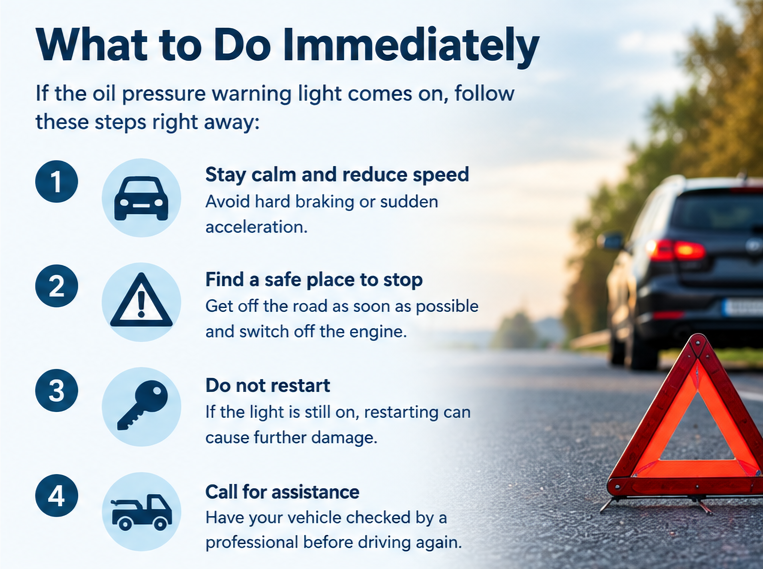
The first few minutes matter most. Follow these steps in order.
- Stay calm and plan your stop. Check your mirrors, signal, and look for the first safe place to pull over, such as a side road, a car park, or a lay by.
- Pull over safely and switch off the engine. Don’t wait until you’re closer to home. Every extra minute with low pressure risks damage. Put the hazard lights on if you’re in a risky position.
- Don’t restart the engine to see if the light goes out. Restarting can cause the very damage you’re trying to avoid.
- Wait a few minutes. Allow the engine to cool and the oil to drain back into the sump, which also gives a more accurate dipstick reading.
- Check the oil level. Park on level ground if you can, and follow the dipstick steps in the next section.
- Look for obvious signs of a problem. Check underneath for oil dripping, and note any smoke, burning smell, or knocking noises you heard before stopping.
- If the level is low, top up carefully with the correct oil. Add a little at a time and recheck, using the grade recommended in your handbook.
- If the light stays on, or the oil level was fine, don’t drive the car. Arrange recovery to a garage instead. A pressure fault with a normal oil level points to a mechanical or sensor problem that needs proper diagnosis.
The sequence is summarised below.
How to Check Your Oil Level Safely
Checking the oil is simple, but it needs care because engine parts and oil can be very hot.
- Park on level ground and make sure the engine is off and the handbrake is on.
- Wait several minutes so the oil can drain back to the sump and the engine can cool a little.
- Pull out the dipstick, wipe it clean with a cloth, and push it fully back in.
- Pull it out again and read the level against the markings, which show the minimum and maximum.
- If the level is near or below the minimum, add the recommended oil gradually, rechecking as you go.
- Avoid overfilling. Too much oil can cause foaming and a rise in crankcase pressure, which creates problems of its own.
Some newer cars have no dipstick and show the oil level through the dashboard menu instead, so check the handbook if you can’t find one. A driver in Ash who has topped up and sees the light go out should still have the car checked, because the underlying reason for the low level, such as a leak, hasn’t gone away.
If You’re on a Motorway or Busy Road
Stopping on a fast road needs extra care. If you can reach a safe place such as an emergency area or the hard shoulder, stop there, switch on your hazard lights, and leave the car by the left hand door where it’s safe to do so. Wait well away from the traffic, behind any barrier, and call for assistance rather than trying to check the oil beside live traffic.
Your personal safety always comes first. A car can be repaired, but you can’t be replaced.
What Not to Do When the Oil Pressure Light Is On
Some well meant reactions make things worse, so it helps to know what to avoid.
| Do | Don’t |
| Pull over at the first safe opportunity | Carry on driving just to get home or reach the next garage |
| Switch off the engine promptly | Rev the engine to see if the light goes out |
| Wait before checking the dipstick | Restart repeatedly to test the light |
| Top up with the correct grade of oil | Add random oil or use a different grade from the handbook |
| Arrange recovery if the light stays on | Rely on an additive to fix the problem |
| Take care around hot engine parts | Remove caps or parts from a hot engine carelessly |
A driver in Farnham who knows the nearest garage is only two miles away might be tempted to limp there. It’s tempting, and it’s still the wrong choice, because a few minutes of driving with no oil pressure is enough to cause lasting damage.
Common Causes of Low Oil Pressure
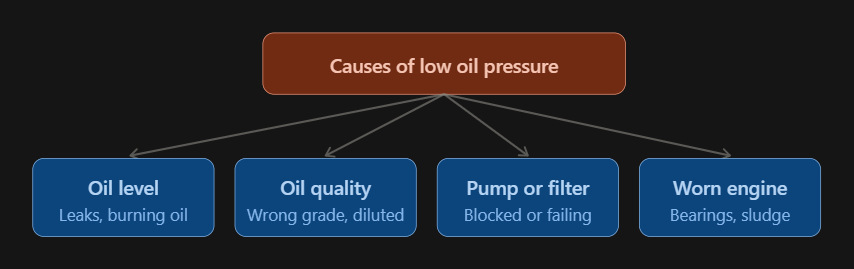
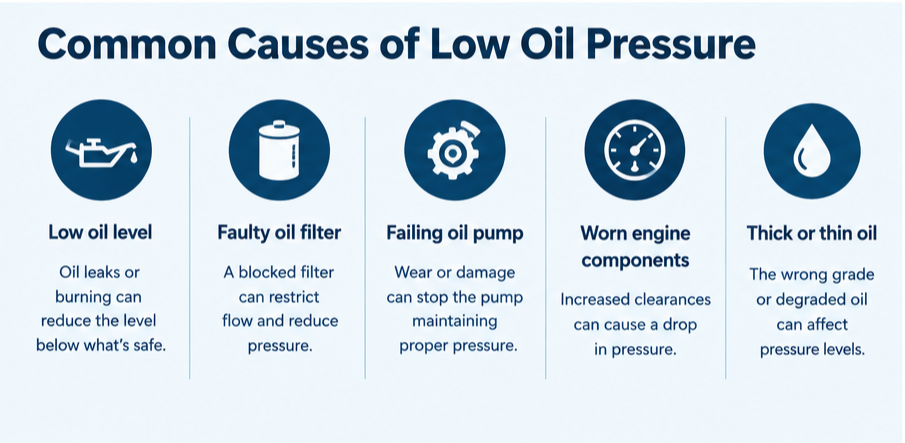
Several different problems can trigger the light, and they range from simple to serious. The diagram below groups the main ones.
| Cause | What Happens | Seriousness |
| Low oil level | Oil lost through leaks or burned off, so the pump draws in air | Often simple to fix, but the reason for the loss needs finding |
| Wrong or diluted oil | Oil that’s too thin, or contaminated with fuel, can’t maintain pressure | Moderate, needs an oil change and investigation |
| Blocked oil filter or strainer | Flow is restricted, so pressure falls | Moderate, often a servicing issue |
| Failing oil pump | The pump can’t generate enough pressure | Serious, needs repair |
| Worn engine bearings | Larger internal clearances let oil escape, so pressure drops, particularly when hot | Serious, often expensive to correct |
| Sludge and blocked passages | Poor maintenance leaves deposits that restrict oil flow | Serious, can cause rapid wear |
| Faulty sensor or wiring | The light comes on even though pressure is fine | Lower, but must be confirmed by testing |
A driver in Tongham whose car has had its oil changed late, or topped up rarely, may be closer to the sludge and low level end of this list, while a high mileage engine is more likely to show wear related pressure loss.
When the Light Flickers at Idle or Comes and Goes
A light that flickers when the engine is hot and idling, then clears as the revs rise, is a classic early warning. As oil warms it thins, and if the engine’s internal clearances have grown with wear, pressure can dip at low revs. It’s a sign of a developing problem rather than something to shrug off.
Intermittent warnings are also among the hardest to pin down, because the fault may not be present when the car is tested. They behave much like the problems described in this guide on why car faults come and go, and they’re best handled by noting exactly when the light appears, such as after a long drive or only at idle. A driver in Ash Vale who records when the flicker happens gives the technician a real head start.
Could It Just Be a Faulty Sensor?
Sometimes, yes. The warning is triggered by an oil pressure sensor or switch, and these can fail or develop wiring faults, causing the light to come on even when pressure is perfectly healthy. That’s the best case, but it can’t be assumed. A technician will confirm the actual oil pressure with a mechanical gauge, which separates a sensor problem from a genuine pressure fault. Until that’s done, the safe assumption is that the warning is real.
What Happens If You Ignore the Warning
Ignoring the light is a gamble with poor odds. Without adequate oil pressure, parts that should be separated by a film of oil begin to make contact. Bearings overheat and wear, cylinder walls are scored, and turbochargers can be starved of lubrication. In the worst cases, the engine seizes entirely and stops dead, sometimes in a dangerous place.
The difference in outcome is dramatic. Stopping promptly and finding a simple cause, such as a low oil level, can mean a quick top up. Continuing to drive can turn the same problem into an engine replacement.
How the Cause Is Diagnosed
A good diagnosis works from the simple to the complex.
- Checking the oil level, condition, and grade, including whether it smells of fuel or looks contaminated.
- Looking for leaks around the engine, sump, filter, and seals.
- Checking the oil filter and, where possible, the condition of the oil.
- Testing actual oil pressure with a mechanical gauge to compare it with the specification.
- Checking the oil pressure sensor, its wiring, and its connector.
- Scanning for related fault codes.
- Where internal wear is suspected, further inspection to find the source.
A driver in North Camp who brings the car in promptly after the light appeared, without driving it further, gives the technician the best chance of finding a cause that can still be repaired economically.
Preventing Oil Pressure Problems
Most oil pressure problems are linked to maintenance, so prevention is largely about routine.
- Check the oil level regularly, ideally monthly and before long journeys.
- Use the grade and specification recommended in your handbook.
- Have the oil and filter changed at the recommended intervals, or sooner for harder use.
- Investigate leaks and drips promptly rather than topping up repeatedly.
- Take any amber oil level or service warning seriously.
- Remember that some engines consume a little oil between services, so don’t assume the level will stay put.
- Keep to the service schedule so that small issues are caught early.
Checking the oil is also part of a sensible pre test routine, and it features among the items in this MOT checklist, which is a handy reference for the basic checks every driver can carry out.
Oil Pressure Problems and the MOT
The oil pressure light itself isn’t the focus of the test, but the problems behind it can matter. Significant oil leaks, where oil is dripping or leaking enough to cause a hazard, can be recorded as defects, and an engine in poor mechanical condition may produce smoke or emissions problems that affect the result. A car that has recently had an oil pressure warning should be checked and repaired before it’s presented for testing.
If your test is approaching, sort any warning light first. Booking an MOT in Aldershot with enough notice for any repairs avoids the stress of a failure and the risk of driving a car with a genuine fault.
Conclusion
The oil pressure warning light is one of the few dashboard signals that demands an immediate response. It means the oil isn’t reaching the engine’s moving parts at a safe pressure, and the difference between acting at once and driving on can be the difference between a minor fix and a ruined engine. The right sequence is simple: pull over at the first safe place, switch off, don’t restart, wait a few minutes, check the oil level, and arrange recovery if the light stays on or the level was normal.
Understanding the likely causes, from low oil and the wrong grade to blocked filters, failing pumps, worn bearings, and faulty sensors, helps you describe the problem clearly and ask good questions. Regular oil checks, timely servicing, and prompt attention to leaks remove most of the risk. For drivers in Aldershot and the surrounding area, a few minutes with the dipstick each month is among the cheapest forms of engine insurance there is, and a local garage such as GForce Tyres can check anything the dipstick can’t.
Frequently Asked Questions
What does the oil pressure warning light mean?
It means the engine’s oil pressure has fallen below a safe level, which can be caused by low oil, a pump or filter problem, engine wear, or a faulty sensor.
Can I drive with the oil pressure light on?
No. You should pull over safely and switch off the engine, because continuing to drive can cause severe and costly engine damage within minutes.
Is a low oil level the same as low oil pressure?
Not exactly. Low oil level is a common cause of low pressure, but pressure can also drop with a normal oil level because of a pump fault, blockage, or worn bearings.
What if I top up the oil and the light goes out?
You should still have the car checked, since the oil was lost for a reason, such as a leak or high consumption, and that cause needs finding.
Why does the light flicker when the engine is idling?
Warm oil is thinner, so a worn engine may lose pressure at low revs. It’s an early warning that should be investigated promptly.
Could the oil pressure light be a false alarm?
It can be, if the sensor or wiring is faulty, but this can only be confirmed by testing the real oil pressure, so the warning should always be treated as genuine until proven otherwise.