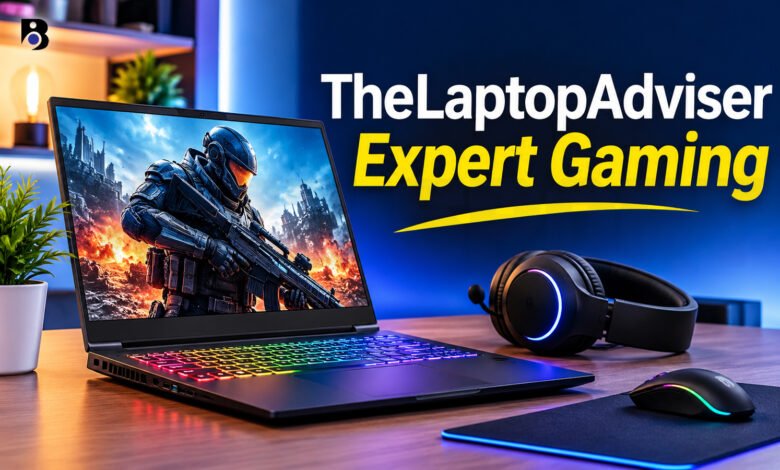
Buying a gaming laptop is exciting, but the spec sheet can feel like a foreign language. GPU, VRAM, refresh rate, NVMe, thermal throttling. Which of these really matter? And which ones are just fancy words on a box?
If you searched for “TheLaptopAdviser expert gaming”, you are probably asking the same thing. You want clear advice from someone who explains laptops in simple words. This guide does that. We will look at what the phrase means, which parts of a gaming laptop matter most, and how to avoid the mistakes many first-time buyers make.
Everything here is based on buying guides and support pages from well-known brands and tech sites. You can find the sources at the end of the article.
What does “TheLaptopAdviser expert gaming” mean?
TheLaptopAdviser is a website about laptops. Its About page says a tech expert named Robert leads the laptop testing and reviews. Many other blogs also use the phrase “TheLaptopAdviser expert gaming” when they talk about gaming laptop reviews.
Those pages usually cover the same ideas:
- How strong the laptop is in games (frame rate and stability)
- How well it stays cool
- How long the battery lasts
- Whether the price matches the performance
Another related phrase, “Expert Games TheLaptopAdviser”, is used for tips on getting more FPS, lowering lag, and tuning laptop settings.
One honest note: the name is used in different ways around the web, and some of these pages are written by other people, not by the site itself. So treat any single page as one opinion. The best way to choose a laptop is to understand the basics yourself, and then use reviews to check the details. That is what the rest of this guide helps you do.
Step 1: Start with the graphics card (GPU)
For gaming, the graphics card matters most. It draws the images you see on screen, so it has the biggest effect on your frame rate. Frame rate is also called FPS, which means frames per second. More FPS usually means smoother play.
Here is what to check:
- Choose a modern, dedicated GPU. A dedicated GPU is a separate graphics chip, like an NVIDIA GeForce RTX or an AMD Radeon. It is much stronger than the basic graphics built into a normal laptop processor.
- Look at the video memory (VRAM). More VRAM helps with sharper screens, ray tracing, and the newest big games. PCWorld suggests at least 16GB of RAM and a GPU with 8GB of VRAM for a modern gaming laptop.
- Check the generation. Microcenter warns that some new models come with a new processor but an older GPU. Always read the exact GPU name in the specs.
- Remember that power matters. The same GPU name can perform very differently in two laptops. Laptop makers decide how much power the GPU can use and how well the laptop cools it. So a thin laptop and a thick laptop with the “same” GPU may not give the same FPS.
A simple tip from Evetech is to pick a GPU one level above your target. That way you can keep your game settings high for a longer time.
Step 2: Pick a processor (CPU) that fits
The CPU is the brain of the laptop. In most games the GPU does more work, but a weak CPU can still slow things down. This is called a bottleneck.
Good starting points are an Intel Core i5 or i7, or an AMD Ryzen 5 or Ryzen 7. Content on the TheLaptopAdviser expert gaming topic often mentions Core i7 and Ryzen 7 for smooth multitasking and gaming. If you also stream, edit video, or run many apps at once, a stronger CPU is worth the money. If you only play and want to save money, a mid-range CPU with a better GPU is often a smarter deal.
Step 3: Get enough RAM
RAM is your laptop’s short-term memory. The Box.co.uk team describes it as workspace. If the workspace is too small, the computer has to use the slower storage drive, and you can feel it as stutters or pauses.
How much do you need?
- 8GB is the old minimum. It can still run some games, but it is tight today.
- 16GB is a good balance for most people. Box.co.uk calls it the practical sweet spot for most laptop buyers.
- 32GB is more future-ready. Digital Citizen reports that Microsoft now sees 32GB as the safer choice for gaming PCs, and says 16GB is closer to the starting point than it used to be.
Here is the key point: RAM does not replace a good GPU. Box.co.uk explains that a laptop with a strong graphics card and 16GB of RAM will often beat a laptop with 32GB of RAM and weaker graphics. If your budget is limited, spend on the GPU first. If the laptop has open memory slots, you can start with 16GB and add more later.
Step 4: Choose fast storage
Storage is where your games and files live. Today, you want a solid-state drive (SSD), not an old hard drive. Microsoft also says the system and the games you play should be on an SSD.
- Type: Look for an NVMe SSD. It loads games and levels faster.
- Size: Evetech suggests 512GB as a sensible starting point. Many games are very large now, so 1TB is more comfortable if your budget allows.
- Upgrade options: SquareTrade notes that most gaming laptops do not let you change the CPU or GPU, but many let you upgrade RAM and storage. If you want to upgrade later, look for SO-DIMM memory slots and two M.2 SSD slots.
Step 5: Look closely at the screen
A strong GPU can be wasted on a poor screen. Four things matter here.
Refresh rate
Refresh rate tells you how many times per second the screen updates. It is measured in hertz (Hz). A 60Hz screen updates 60 times each second, and a 144Hz screen updates 144 times. Higher numbers make fast movement look smoother.
- 120Hz to 144Hz is a good target for most players. Kingston and Best Buy both recommend at least 144Hz or 120Hz for smooth play.
- 240Hz or more is mainly for competitive players in fast shooters and similar games.
Tom’s Hardware adds a useful reminder: to use a very high refresh rate, you need a strong GPU and settings that focus on frame rate, not just beautiful graphics.
Resolution
Full HD (1920 x 1080) is the sweet spot for smooth frame rates. QHD (2560 x 1440) is sharper but asks more from the GPU. 4K looks great, but it is very demanding on a laptop.
Panel type
Dell makes an interesting point. If your budget is limited, an OLED screen can be a better choice than chasing the highest refresh rate. A 165Hz OLED display can look and feel better for story games and single-player games than a faster screen with a plain panel. If you mainly play fast online shooters, refresh rate can matter more.
Sync technology
Features like NVIDIA G-SYNC and AMD FreeSync help the screen match the GPU, which reduces tearing and makes motion smoother.
Step 6: Take cooling seriously
This is the part many buyers skip, and it can be the most important. Gaming parts make a lot of heat. If the laptop cannot move that heat away, it slows itself down to stay safe. This is called thermal throttling.
ASUS describes it as the laptop putting on the brakes to cool down. HP adds that it is a safety feature found in every gaming laptop, not a sign of bad design. According to HP, most CPUs and GPUs start to throttle at around 95 to 100°C.
What does throttling feel like? You may see:
- FPS that drops suddenly after 15 or 20 minutes of play
- Stuttering or lag spikes
- Longer loading times
Reviews that talk about TheLaptopAdviser expert gaming style testing often look at how a laptop handles long sessions, because a laptop that is fast for five minutes but slow after an hour is not a good gaming laptop. An Acer article puts it well: cooling capacity is one of the least advertised but most important specs on a gaming laptop.
How to keep your laptop cool
Even a good laptop runs better with some care. These tips come from ASUS, HP, and Acer:
- Clean the vents and fans. Dust blocks airflow and is a very common cause of throttling.
- Raise the back of the laptop or use a cooling stand. Gaming laptops breathe from the bottom.
- Close apps you do not need while you play.
- Use the performance mode in the maker’s app, so the fans start earlier.
- Set a frame rate limit if your GPU is working harder than it needs to.
- Play in a cooler room if you can.
- If the laptop is old and still runs hot after cleaning, ask a repair shop about new thermal paste.
When you read reviews, look for tests that show FPS over a long time, not only a short test.
Step 7: Think about battery, size, and weight
Be ready for a trade-off. Gaming laptops use a lot of power. Rtings notes that the battery on a gaming laptop often lasts only about an hour while gaming, and that this is normal for this type of laptop. So plan to play while plugged in.
Battery life still matters for the rest of your day. Many laptops have a power-saving mode that helps with school or office work. Some people also carry their laptop every day, so weight and size matter. A thin laptop is easier to carry, but it may have less room for cooling. A thicker laptop is often cooler and stronger, but heavier and louder.
Ask yourself one question: where will I use this laptop most? If the answer is “at my desk”, pick power and cooling. If the answer is “everywhere”, look for a balance.
Step 8: Match the laptop to your budget and your games
You do not need the most expensive laptop to have fun. Best Buy gives a helpful example of an entry-level setup: an RTX 3050 GPU, an Intel i5 or Ryzen 5 processor, and 8GB to 16GB of RAM. It is a good fit for casual players and students. Newer models will have newer names, but the idea stays the same. Entry-level is fine for lighter and older games, and higher levels help with new titles at high settings.
Before you buy, make a short list:
- Which games do I play, and what are their system requirements?
- What screen resolution do I want?
- Do I need to carry the laptop every day?
- Do I also use it for school, work, streaming, or video editing?
- How much can I spend?
Good value often comes from a balanced build. A laptop with a great GPU, 16GB of RAM, a fast SSD, and a 144Hz screen usually beats a laptop with one flashy spec and weak parts everywhere else.
A quick checklist before you click “buy”
- Does the GPU fit the games and screen resolution I want?
- Is the GPU a current model, and is the exact name clear?
- Is there at least 16GB of RAM, and can I upgrade it?
- Is the SSD big enough, and is there a second slot?
- Is the screen at least 120Hz or 144Hz?
- Do reviews show steady FPS during long play?
- Is the warranty clear, and is support available in my country?
- Is the weight and battery life okay for how I live?
Common mistakes to avoid
Looking only at the CPU name. Many shoppers see “Core i9” and think the laptop must be amazing. For gaming, the GPU and cooling often matter more.
Paying for more RAM before a better GPU. As we saw, graphics power does most of the work in games.
Ignoring cooling and noise. A hot, loud laptop is tiring to use, and it may slow down.
Trusting one source only. Read at least two or three reviews. If one review says a laptop is perfect and the rest mention heat problems, listen to the group.
Forgetting the warranty. Gaming laptops work hard. A good warranty can save you money later.
Final thoughts
Choosing a gaming laptop gets easier when you know what matters. Start with the GPU. Add a fair CPU, 16GB of RAM or more, and a fast SSD. Pick a screen of at least 120Hz or 144Hz, and check that the cooling can handle long sessions. Then use reviews, including pages about TheLaptopAdviser expert gaming, to compare real test results.
Take your time, write down your needs, and do not rush for a deal that does not fit them. A balanced laptop that stays cool will make your games feel better for years.
Frequently asked questions
What is TheLaptopAdviser expert gaming?
It is a phrase used for gaming laptop reviews and advice from TheLaptopAdviser, a website about laptops. Pages using this phrase usually explain performance, cooling, battery life, screens, and value in simple words. Because other websites also use the name, it is smart to compare several sources before you buy.
How much RAM and storage do I need in a gaming laptop?
For most people, 16GB of RAM and a 512GB to 1TB NVMe SSD is a solid starting point. If you stream, mod games, or like to keep many apps open, 32GB is a safer choice. A laptop with extra memory slots and a second SSD slot gives you room to upgrade later. Remember that a good GPU matters more than a large amount of RAM.
Is thermal throttling bad for my gaming laptop?
Throttling itself is a safety feature. It protects the parts from too much heat. The problem is the lower performance you get when it happens a lot. If your FPS drops after a short time, clean the vents, raise the laptop for better airflow, and check your power mode. If it keeps happening, the cooling system may be too weak for the parts inside, and a different model could be a better choice.