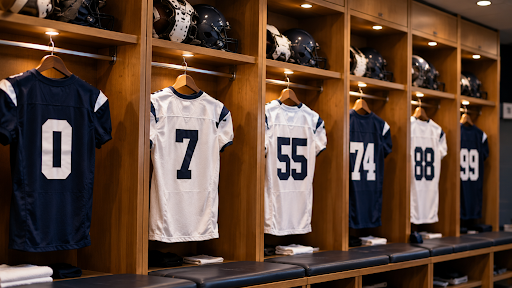
Football jersey number rules exist mainly for the officials. A player’s number tells them who is allowed to catch a forward pass: anyone wearing 50 through 79 is an ineligible receiver at every major level of the game, which is why offensive linemen wear those numbers.
Beyond that shared rule, the NFL, college football and high school football handle numbers differently. This guide covers what each level allows in 2026, what changed in recent seasons, and the size and color rules that apply to the jersey itself.
NFL jersey number rules by position
The NFL first standardized numbers by position in 1973. These are the ranges in place since the 2023 season:
| Position | Allowed numbers |
| Quarterback | 0–19 |
| Running back, fullback, H-back | 0–49, 80–89 |
| Wide receiver | 0–49, 80–89 |
| Tight end | 0–49, 80–89 |
| Offensive line | 50–79 |
| Defensive line | 50–79, 90–99 |
| Linebacker | 0–59, 90–99 |
| Defensive back | 0–49 |
| Kicker and punter | 0–49, 90–99 |
A few details matter on game day:
- A player wearing an ineligible number who lines up to catch a pass must report to the referee first. The referee then announces it to the stadium, for example “Number 61 has reported as eligible.”
- A number is tied to the player’s position when he first receives it. He can keep it after changing positions, unless he moves from an eligible spot to the offensive line.
- The rulebook sets no range for long snappers. Most wear numbers in the 40s or 50s.
- Teams may retire numbers, but the league discourages it. If a team runs out of numbers at a position, it must reissue a retired one.
How the NFL rules changed in 2021 and 2023
Until 2021, single digits belonged to quarterbacks, kickers and punters. Running backs and defensive backs wore 20–49, tight ends 40–49 or 80–89, and linebackers 40–59 or 90–99.
- 2021: On April 21, 2021, owners approved a Kansas City Chiefs proposal that opened 1–49 to running backs, receivers, tight ends, linebackers and defensive backs. The reason was practical. After practice squads expanded in 2020, some teams ran short of legal numbers at certain positions.
- 2023: On March 28, 2023, owners approved a Philadelphia Eagles proposal that made No. 0 legal for every position except offensive and defensive linemen. Kickers and punters, previously limited to 1–19, gained 0–49 and 90–99.
The NFL still does not allow 00. Defensive linemen also still cannot wear single digits, even though the linebackers lined up beside them can.
College football (NCAA) number rules
College football gives players far more freedom than the NFL. Any player can wear 0 through 99. The NCAA rulebook only “strongly recommends” a numbering system for the offense (backs 1–49, centers 50–59, guards 60–69, tackles 70–79, ends 80–99) and sets nothing for the defense.
The rules that are mandatory:
- At the snap, the offense must have at least five players on the line numbered 50–79.
- No. 0 has been legal since the 2020 season.
- Two players on the same team may share a number, but never more than two, and they cannot be on the field for the same down. The two-player limit also dates to 2020.
- Numbers must be at least 8 inches tall on the front and 10 inches on the back, in a color that clearly contrasts with the jersey.
This is why college defensive linemen sometimes wear single digits, something the NFL does not allow. Texas is the one state whose high schools play under NCAA rules instead of NFHS rules.
High school (NFHS) number rules
Most U.S. high schools play under the rules of the National Federation of State High School Associations (NFHS). Its numbering rules are short:
- Players can wear 0 through 99. No. 0 became legal in 2022, but a number may not start with a zero, so 00 or 07 is illegal.
- Offensive linemen wear 50–79. Backs and ends wear 0–49 or 80–99.
- At the snap, the offense needs at least five players numbered 50–79 on the line, with an exception for scrimmage kick formations.
- Defensive players have no number restrictions.
At the youth and high school level, numbers often follow the equipment room rather than the depth chart. Many schools don’t replace jerseys every year, and the 50s, 60s and 70s usually come in the largest sizes, so a player’s number can depend on which jersey fits. When a program orders new custom football uniforms, it can plan the size run around its roster instead, with linemen numbers in bigger cuts and skill-position numbers in smaller ones.
Eight-man and six-man football are the exception. Players there can wear any number, because eight-man has only three ineligible receivers and six-man has none.
Number size, color and placement rules
High school rules are the most detailed about how numbers look, because officials need to read them from across the field.
- Size: at least 8 inches tall on the front and 10 inches on the back, centered horizontally. College uses the same 8- and 10-inch minimums.
- Stroke width: the body of each digit should be about 1½ inches wide.
- Color: since 2024, the body of the number must be one solid color that clearly contrasts with the jersey. Before that, a number in the jersey’s own color with a contrasting border of at least ¼ inch was allowed.
- Consistency: the color and style of the number must be the same on the front and back.
- Home and away: the visiting team wears jerseys with an all-white body, and the home team wears a dark color that clearly contrasts with white.
The high school rulebook only requires numbers on the front and back. Sleeve, shoulder and helmet numbers are common, but optional.
Football jersey number rules at a glance
| Rule | NFL | College (NCAA) | High school (NFHS) |
| Legal numbers | 0–99, set by position | 0–99, any position | 0–99, no leading zero |
| No. 0 legal since | 2023 (not for linemen) | 2020 | 2022 |
| Offensive linemen | 50–79 | 50–79 recommended; five on the line at the snap | 50–79; five on the line at the snap |
| Defensive linemen | 50–79, 90–99 | Any number | Any number |
| Single digits for receivers and backs | Yes, since 2021 | Yes | Yes |
For a school or youth team, the checks run in a simple order: confirm which rulebook your state follows, keep 50–79 for linemen, and check number size and contrast before the jerseys are made. Most uniform suppliers, Hamco Sports Inc. among them, review number size and placement against league specs at the design stage, but the state association has the final say on what is legal.