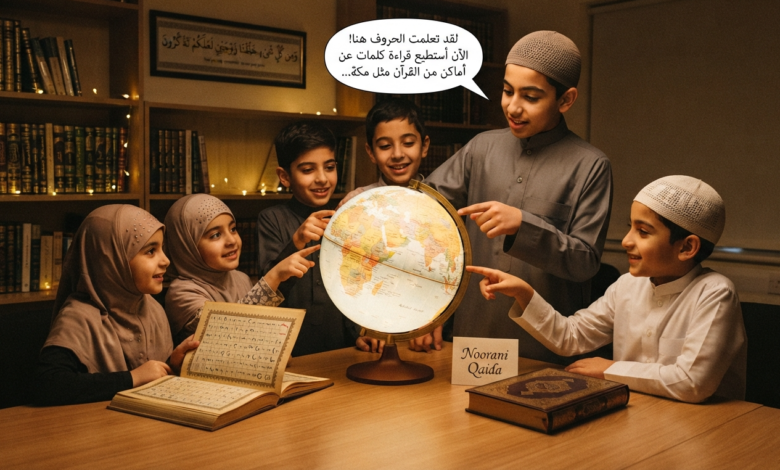
Learning to read the Quran takes time and Noorani Qaida helps children build the skills they need before reading it. With time, they learn to recognize Arabic letters, understand how to pronounce them, join letters together, and follow rules. As they develop these skills, they become ready to move towards Quran reading.
However, just finishing the Noorani Qaida one time does not mean a child is ready to start on the Quran recitation. Some kids can recognize Arabic letters very well but struggle with more complex words. One should not focus on completing lessons, but observe how the child can use what they have learned. Recognizing these signs helps you choose the correct time for them to make the transition.
When is a Child Ready to Move?
Children develop reading skills at their own pace. So a specific age should not be the only factor to decide when they should begin reading the Quran. Parents and teachers should look for signs that show how well a child understands the Noorani Qaida before promoting them to the next level. Parents should also ask their child if they feel ready and comfortable and also notice their progress when they start recitation. This tells if a child can apply what they have learned and not simply complete the lessons for the sake of progress.
Below are some pointers to consider in this regard:
1. Recognizing Arabic Letters
A child recognizing Arabic letters without any help is a clear sign of readiness. A child should be able to identify them in different ways. They should also understand how letters appear in the beginning, middle, and final forms, because many Arabic letters’ shapes change when joined with other letters to form a word.
Parents can check this with simple and easy practice. If a child recognizes a letter in an unfamiliar word, it shows that their understanding is good and they can start on recitation.
2.Understanding How Arabic Letters Join
Arabic letters rarely appear separately in written words. Children need to know how letters connect and how their shape changes depending upon their position in a word. This skill is very important because while reading the Quran, recognizing complete words is necessary.
A child who understands this can read simple letter combinations in the Quran. Pausing from time to time is completely normal. They need time to understand how the word will sound after joining all the letters together.
3. Pronouncing Letters and Basic Sounds
Children also need to pronounce the letters correctly especially those that have similar sounds. For example, it requires knowledge to distinguish between س (seen) and ص (saad), or ت (Taa) and ط (taa). With regular practice, one can recognize these differences as the difference is essential when reciting the Quran.
A child should also know the basic vowel marks which are Fatha, Kasra, and Damma, and understand how each one changes the letter’s sound. At early stages, perfect pronunciation is not necessary, but basic understanding of these sounds is.
Applying Qaida Skills While Reading the Quran
Children also need to combine above mentioned skills during reading. This helps to know whether they can move from Qaida and start reading simple Arabic sentences. Teachers can look for a few additional abilities to understand how likely a child is to handle the next stage.
1.Reading Arabic Words with Confidence
Reading quickly is not what makes a child ready for Quran reading. What is important is to read simple combinations without stopping to identify every letter. The flow is what needs to be perfect. They should be able to see the upcoming word while reading so they don’t take too many pauses.
Occasional pauses and mistakes are completely normal, but if a child is stopping on every letter, they may spend more time on revision. Once they can read simple words and sentences, they can move on to Quranic verses.
2. Understanding Basic Reading Rules
As Noorani Qaida teaches children basic reading signs, which they will encounter throughout the Quran including Sukoon, Tanween, and Shaddah, along with the vowels that they already learned. They should have an understanding of how these signs change pronunciations and be able to apply them.
There is no need to master every rule before starting Quran reading. In fact, some rules only even appear in the Quran. They can be introduced gradually as a child progresses.
3. Showing Confidence When Reading New Lessons
Confidence is another sign of readiness. A child who is ready to move forward will show it and listen to corrections, and make another attempt when they get something wrong.
This can be easily observed during practice or parents can ask teacher how the child handles new exercises. If you think that the child can handle more challenging reading material, you can begin with short Quran verses.
Transition from Qaida to Quran Reading
Once the child has developed the skills that are needed for Quran reading they can be transferred to Quran recitation using a step by step process. This transition can feel like a big change to a child, but regular practice and proper guidance can make it easier. Below are some tips to make things easier:
1. Start With Short Paragraphs
Begin with short paragraphs that include familiar letters. Don’t ask a child to read several paragraphs at once. This allows them to use the skills they have learned instead of getting confused with long texts. The teacher can explain difficult combinations as they come while reading to aid the Arabic language understanding. As the child becomes more confident, the length of lessons can be increased accordingly.
2. Maintain Regular Practice with Proper Teacher Guidance
A few moments of consistent reading can be more helpful than occasional long lessons. Regular feedback from a qualified teacher is very important because children do not always notice their own mistakes.
For families who cannot find Quran learning options nearby can go for the learn Quran online option which is being used widely. Live lessons provide an opportunity for teachers to listen to only one child’s recitations and correct mistakes as they happen. You can find qualified Quran tutors in online Quran learning when you go with a reputed learn Quran academy.
3. Give Children Time to Adjust
Even after completing the Noorani Qaida, children need time to read directly from the Quran. Parents should avoid forcing it and let children progress at a manageable pace. It is also important not to compare their progress with other kids. Encouragement helps children learn a new lesson with confidence instead of feeling under pressure.
Conclusion
Moving from Noorani Qaida to Quran reading is an important milestone. Children need a solid foundation before taking this step. They need to have a good grip on what they learned in Noorani Qaida. Arabic letters, joining them easily, pronouncing, and reading simple words should feel like no work to them. And if they can do all that, it is a sign of readiness.
Instead of fixing their age for transition, parents and teachers should look for these skills. Since the main progress of a child’s Quran journey is dependent on the Quran tutors going for the online Quran learning option seems more suitable. It is essential that you choose a practical learn Quran academy that has a wide range of Quran tutors and you can choose the one which suits your child the best.